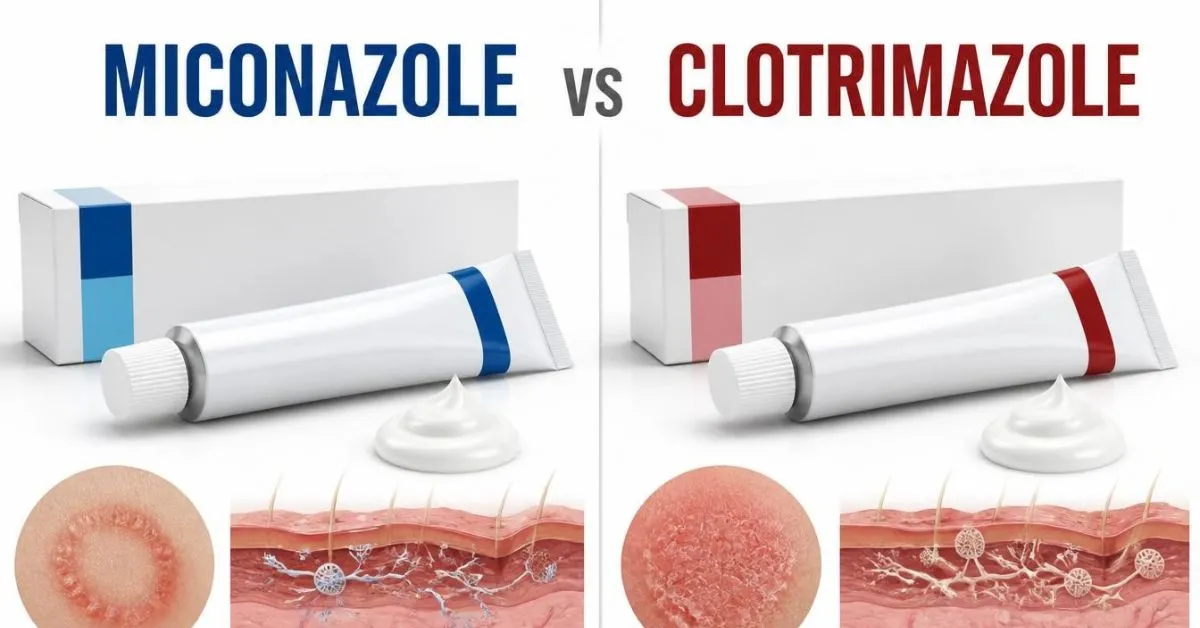
Miconazole and clotrimazole are both azole antifungals used to treat vaginal yeast infections and some fungal skin infections. Neither is always better than the other.
The right choice depends on the infection, product, strength, treatment schedule, symptoms, medical history, and other medicines you take. Miconazole also has an important interaction with warfarin.
Key Takeaways
- Miconazole and clotrimazole are both azole antifungals.
- Both can treat uncomplicated vaginal yeast infections.
- Both are also used for certain fungal skin infections.
- A shorter treatment does not mean the medicine is stronger.
- A higher percentage on the package does not automatically mean a stronger treatment.
- Miconazole can interact with warfarin and may increase bleeding risk.
- Vaginal creams and suppositories may weaken latex condoms and diaphragms.
- Pregnancy, recurrent infections, severe symptoms, or an unclear diagnosis may need medical advice.
- If symptoms do not improve or come back soon after treatment, do not keep switching antifungals on your own.
Miconazole vs Clotrimazole: What’s the Difference?
Miconazole and clotrimazole are similar antifungal medicines. Both belong to the imidazole class of azole antifungals.
They work by stopping the growth of fungi.
The main difference is not that one drug is simply “stronger.” They come in different products, strengths, forms, and treatment schedules.
Both can be used for certain vaginal and skin fungal infections. The correct product depends on where the infection is and which product is made for that area.
For uncomplicated vaginal yeast infections, both miconazole and clotrimazole are established topical treatment options.
Miconazole vs Clotrimazole at a Glance
| Feature | Miconazole | Clotrimazole |
| Drug class | Azole antifungal | Azole antifungal |
| Vaginal yeast infections | Yes | Yes |
| Some fungal skin infections | Yes | Yes |
| Vaginal forms | Cream, suppository | Cream |
| Treatment length | Depends on product | Depends on product |
| OTC products | Available | Available |
| Local irritation | Possible | Possible |
| Warfarin concern | Important | Less prominent |
| Best choice | Depends on the situation | Depends on the situation |
The key point: compare the actual product, not just the drug name.
Miconazole vs Clotrimazole for Yeast Infection
A vaginal yeast infection is also called vulvovaginal candidiasis (VVC). It is usually caused by an overgrowth of Candida yeast.
Common symptoms include:
- Vaginal itching
- Burning
- Soreness
- Redness
- Pain or discomfort during sex
- Discomfort when urinating
- Abnormal vaginal discharge
These symptoms can also occur with other vaginal conditions, so symptoms alone do not always prove that you have a yeast infection.
For uncomplicated VVC, both miconazole and clotrimazole are topical azole options.
Miconazole Treatment Options
Miconazole vaginal products come in different forms and treatment schedules.
Examples include:
- Miconazole 2% cream for 7 days
- Miconazole 4% cream for 3 days
- Miconazole 100 mg vaginal suppository for 7 days
- Miconazole 200 mg vaginal suppository for 3 days
- Miconazole 1,200 mg vaginal suppository for 1 day
These are examples of treatment regimens listed by the CDC. The product you buy may have different instructions, so always follow its label or your healthcare professional’s directions.
A 1-day product does not mean the infection is more serious or that the medicine is automatically stronger.
Clotrimazole Treatment Options
Clotrimazole vaginal products also come in different strengths and treatment schedules.
Examples include:
- Clotrimazole 1% cream for 7–14 days
- Clotrimazole 2% cream for 3 days
The correct schedule depends on the product.
Do not compare products by percentage alone. A higher percentage does not automatically mean a stronger or better treatment.
Which Is Better: Miconazole or Clotrimazole?
Neither is automatically better.
For an uncomplicated vaginal yeast infection, both can be effective treatment options when used correctly.
Your choice may depend on:
- The product available to you
- Treatment length
- Cream or suppository preference
- Previous response
- Cost
- Other medicines you take
- Pregnancy
- Your symptoms
- The exact infection being treated
The best choice is not always the drug with the shortest treatment or the highest percentage.
It is the product that is appropriate for the infection and safe for you.
Miconazole vs Clotrimazole: Which Works Faster?
There is no simple winner.
Both medicines come in products with different treatment schedules. Some products are used for 1 day, while others are used for 3 or 7 days.
But treatment length is not the same as how fast your symptoms improve.
A 1-day product does not mean the infection is cured in one day. Follow the full directions for the product you are using.
If your symptoms are not improving, get medical advice instead of repeatedly changing products.
Is Clotrimazole Stronger Than Miconazole?
Not in a simple way.
You cannot decide which medicine is stronger just by looking at the percentage on the package.
Different products can contain different concentrations because they are designed for different formulations and treatment schedules.
For example, comparing a 1% product with a 2% product does not tell you which medicine is more powerful overall.
The better question is:
Which product and treatment schedule are right for the infection being treated?
Miconazole vs Clotrimazole for Itching
Both medicines can help when vaginal itching is caused by a yeast infection that responds to the antifungal.
But itching does not always mean you have a yeast infection.
Other vaginal conditions can cause itching, burning, irritation, or discharge.
If this is your first suspected yeast infection, your symptoms are unusual, or treatment does not help, talk with a healthcare professional instead of repeatedly using antifungal products.
Miconazole vs Clotrimazole: Side Effects
Both medicines can cause local side effects.
Possible effects include:
- Burning
- Itching
- Redness
- Irritation
- Soreness
- Local discomfort
These effects are often mild, but severe or unusual symptoms should not simply be blamed on the medicine.
Get medical advice if you develop symptoms such as:
- Fever
- Chills
- Significant pelvic or abdominal pain
- Foul-smelling discharge
- Severe irritation
- A rash or allergic reaction
Miconazole & Warfarin: An Important Difference
One of the most important safety points in this comparison is miconazole and warfarin.
Miconazole can increase the effect of warfarin and may increase the risk of bleeding. This interaction has been reported with topical, vaginal, and oral miconazole.
If you take warfarin, talk with a doctor or pharmacist before using miconazole.
Do not assume that a vaginal or topical product cannot interact with another medicine.
Can Miconazole & Clotrimazole Be Used Together?
You generally should not use miconazole and clotrimazole together unless a healthcare professional tells you to do so.
Both are azole antifungals.
Using two similar antifungal medicines does not automatically make treatment work better. It may also increase irritation or make it harder to tell which product caused a reaction.
Use the product that is appropriate for your condition and follow its directions.
Do Miconazole & Clotrimazole Affect Condoms?
They can.
Some vaginal creams and suppositories are oil-based and may weaken latex condoms or diaphragms.
This can reduce their ability to prevent pregnancy or protect against sexually transmitted infections.
Check the label of the exact product you are using for its instructions about latex condoms and diaphragms.
Miconazole vs Clotrimazole During Pregnancy
Pregnancy changes the treatment decision.
For vaginal yeast infections during pregnancy, CDC guidance recommends topical azole treatment for 7 days.
Oral fluconazole is not recommended for treating VVC during pregnancy.
If you are pregnant and think you have a yeast infection, talk with your healthcare professional before choosing an OTC product.
Do not assume that an OTC medicine is automatically the best choice during pregnancy.
Miconazole vs Clotrimazole for Recurrent Yeast Infections
If yeast infections keep coming back, do not simply keep switching between miconazole and clotrimazole.
CDC defines recurrent VVC as three or more episodes in less than one year.
Recurrent infections may have different causes. They can also involve Candida species that do not respond as well to standard azole treatment.
A healthcare professional may need to confirm the diagnosis and identify the type of Candida causing the infection.
If you have repeated infections, proper diagnosis is more important than finding a “stronger” OTC antifungal.
Miconazole vs Clotrimazole for Severe Yeast Infections
Severe VVC can include extensive redness, swelling, skin breaks, or severe irritation.
Short treatment courses may not work as well for severe infections.
If your symptoms are severe, do not assume that using more OTC medicine will fix the problem.
A healthcare professional can decide whether you need a longer treatment course or a different approach.
Miconazole vs Clotrimazole for Skin Infections
The answer can be different when you are treating a fungal skin infection.
Both miconazole and clotrimazole are used for certain skin fungal infections, including:
- Athlete’s foot
- Ringworm
- Jock itch
- Some other fungal skin infections
However, not every product is made for every condition.
A vaginal product should not automatically be used on the skin, and a skin product should not automatically be used vaginally.
Check the product label for the exact condition and body area.
For skin infections, use the medicine for the full time stated on the label unless a healthcare professional tells you otherwise.
Which One Should You Choose?
For an uncomplicated vaginal yeast infection, miconazole or clotrimazole may be appropriate when used as directed.
A simple way to think about the choice is:
Choose Miconazole If…
- A suitable miconazole product fits your needs.
- You prefer one of its available treatment schedules.
- You have used it successfully before and the current symptoms are consistent with a previously diagnosed infection.
- You do not have an important reason to avoid it.
- You are not taking warfarin without first discussing the choice with a healthcare professional.
Choose Clotrimazole If…
- A suitable clotrimazole product fits your needs.
- You prefer its available formulation or treatment schedule.
- You have used it successfully before and the current symptoms are consistent with a previously diagnosed infection.
- It is appropriate for the infection you are treating.
Talk With a Healthcare Professional First If…
- You take warfarin.
- You are pregnant.
- This is your first suspected yeast infection.
- Your symptoms are severe.
- You have fever or chills.
- You have pelvic or abdominal pain.
- You have foul-smelling discharge.
- Your symptoms keep coming back.
- OTC treatment has not worked.
- Your symptoms return soon after treatment.
- You are not sure the symptoms are caused by a yeast infection.
The goal is not to find the strongest antifungal.
The goal is to use the right treatment for the right infection.
When Should You See a Doctor?
Get medical advice instead of repeatedly trying OTC antifungals if:
- This is your first suspected yeast infection.
- Your symptoms are severe.
- You have fever or chills.
- You have pelvic or abdominal pain.
- You have foul-smelling discharge.
- Your symptoms do not improve after treatment.
- Your symptoms get worse.
- Your symptoms return within a short time after treatment.
- You have repeated yeast infections.
- You are pregnant.
- You take warfarin.
- You have diabetes or a condition that weakens your immune system.
- You are unsure whether you have a yeast infection.
This matters because itching, burning, pain, and discharge can have several causes.
Repeatedly treating the wrong condition with an antifungal can delay the correct diagnosis.
FAQs:
Is miconazole or clotrimazole better for a yeast infection?
Neither is universally better. Both are established topical azole treatments for uncomplicated vaginal yeast infections. The better option depends on the product, treatment schedule, symptoms, medical history, and other medicines you take.
Is clotrimazole stronger than miconazole?
No simple strength ranking applies. Different products have different concentrations and formulations. A higher percentage does not automatically mean a stronger or better treatment.
Which works faster, miconazole or clotrimazole?
Neither has a universal speed advantage. Both come in products with different treatment schedules. A shorter course does not automatically mean faster or stronger treatment.
Can you use miconazole and clotrimazole together?
You should not normally combine them unless a healthcare professional tells you to. Both are azole antifungals, and using two similar medicines does not automatically improve treatment.
Can miconazole and clotrimazole treat skin fungus?
Yes. Topical products containing miconazole or clotrimazole can treat certain fungal skin infections, such as athlete’s foot, ringworm, and jock itch. Use a product labeled for the specific condition and body area.
Can you use miconazole or clotrimazole during pregnancy?
Topical azole antifungals are recommended for vaginal yeast infections during pregnancy, with CDC guidance recommending a 7-day topical course. Talk with your healthcare professional before self-treating while pregnant.
What if the yeast infection keeps coming back?
Do not keep switching OTC antifungals on your own. Recurrent VVC may need testing to confirm the diagnosis and identify the Candida species involved.
What if miconazole or clotrimazole does not work?
If symptoms do not improve after treatment, get medical advice. The symptoms may have another cause, or the infection may need a different treatment.
Conclusion:
Miconazole vs clotrimazole does not have one universal winner.
Both are azole antifungals that can treat uncomplicated vaginal yeast infections and certain fungal skin infections. For many people, the better choice depends on the infection, product formulation, treatment schedule, symptoms, medical history, and other medicines.
If you are choosing an OTC treatment for a typical, previously diagnosed yeast infection, either medicine may be an appropriate option when used according to the product directions.
But there are important exceptions.
If you take warfarin, are pregnant, have severe or recurrent symptoms, have an unclear diagnosis, or do not improve after treatment, talk with a healthcare professional.
The most important difference is not which medicine is “stronger.”
It is which treatment is appropriate and safe for your specific situation.

Harry Jack is a content writer at ReplyGenius.com who specializes in practical, natural sounding replies for texts, social media, relationships, and everyday conversations.