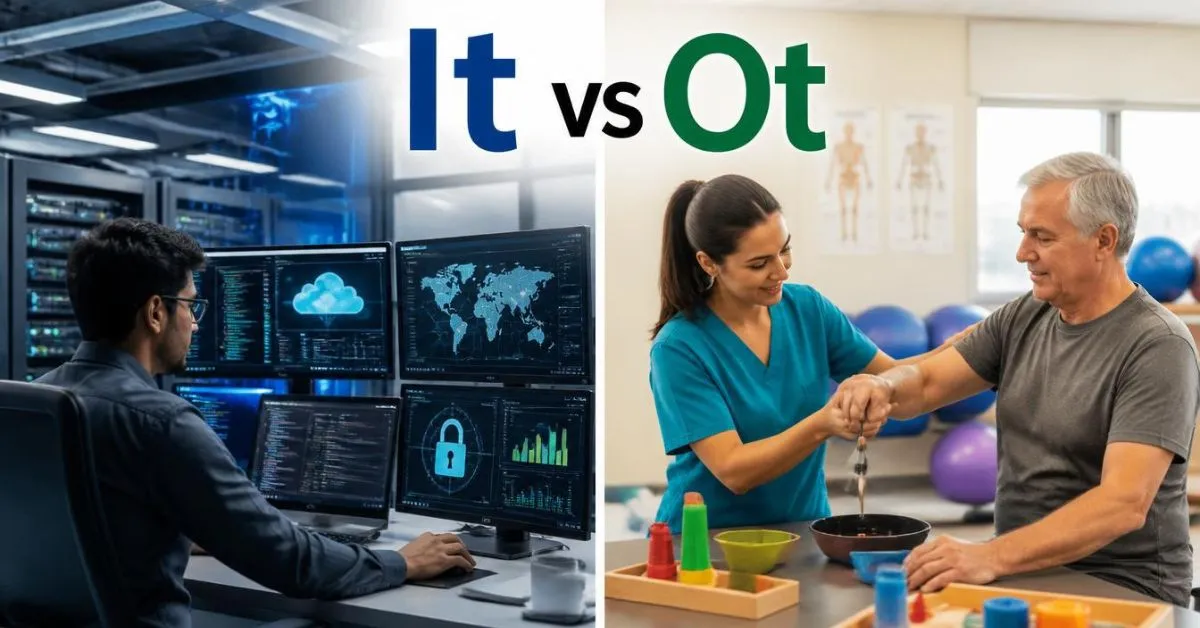
IT vs OT compares Information Technology and Operational Technology. IT manages data, software, computers, networks, and business systems. OT monitors and controls physical equipment and processes.
IT usually focuses on information and digital services, while OT focuses on safe, reliable physical operations. Modern organizations often connect both through IT/OT convergence.
Key Takeaways
- IT manages information, applications, computers, networks, and business systems.
- OT monitors and controls machines, equipment, and physical processes.
- IT and OT have different operating needs, but they increasingly work together.
- OT commonly includes PLCs, SCADA, HMIs, DCS, sensors, and industrial control systems.
- IT security often focuses heavily on protecting information, while OT security must also consider availability, reliability, and safety.
- Connecting IT and OT can improve visibility and efficiency but can also create new cybersecurity risks.
What Is IT?
Information Technology (IT) is the use of computers, software, networks, and digital systems to create, process, store, manage, and share information.
IT supports many of the digital tasks people perform every day.
Common IT systems include:
- Computers and laptops
- Servers
- Databases
- Cloud services
- Business applications
- Email platforms
- Enterprise networks
- File storage
- Identity and access systems
- Cybersecurity tools
For example, a company may use IT to manage employee accounts, store customer information, process payments, run its website, and communicate with customers.
The main focus of IT is information and digital services.
What Is OT?
Operational Technology (OT) is technology used to monitor or control physical equipment, machines, and processes.
OT is common in environments where digital systems interact directly with the physical world.
Examples include:
- Manufacturing plants
- Power facilities
- Water systems
- Transportation
- Industrial sites
- Building automation
- Energy systems
Common OT technologies include:
- Programmable logic controllers (PLCs)
- Supervisory control and data acquisition (SCADA)
- Human-machine interfaces (HMIs)
- Distributed control systems (DCS)
- Sensors
- Actuators
- Industrial controllers
- Industrial control systems (ICS)
For example, a factory can use sensors to measure temperature, pressure, speed, or other conditions. A PLC can process those signals and control equipment based on programmed instructions.
The main focus of OT is monitoring and controlling physical operations.
IT vs OT: What Is the Main Difference?
The simplest way to remember the difference is:
IT manages information. OT manages physical operations.
But the difference is not only about the type of technology. IT and OT can also differ in their environments, priorities, maintenance needs, and approach to cybersecurity.
An IT system might tell a company how many products were sold.
An OT system might help control the machine that produced those products.
That distinction makes IT and OT easier to understand.
IT vs OT: Key Differences
1. Purpose
IT is designed mainly to manage information and support business activities.
It helps organizations:
- Store and process data
- Run applications
- Communicate
- Manage users
- Share information
- Support business decisions
OT is designed to monitor and control physical processes.
It helps organizations:
- Monitor equipment
- Control machines
- Automate processes
- Collect sensor readings
- Manage industrial operations
- Keep physical processes running
So, IT is generally centered on information, while OT is centered on operations.
2. Systems & Devices
IT commonly uses general-purpose technology.
Examples include computers, servers, databases, routers, cloud platforms, and business applications.
OT often uses specialized technology designed for operational environments.
| IT Devices and Systems | OT Devices and Systems |
| Computers | PLCs |
| Servers | Industrial controllers |
| Databases | Sensors |
| Cloud platforms | Actuators |
| Business applications | SCADA |
| Enterprise networks | HMIs |
| Email systems | DCS |
| Storage systems | Industrial control systems |
This is not an absolute dividing line. Some technologies and systems can support both IT and OT functions.
3. Environment
IT systems are commonly found in:
- Offices
- Data centers
- Cloud environments
- Corporate networks
- Business operations
OT systems are commonly found in:
- Factories
- Power plants
- Water facilities
- Industrial sites
- Transportation systems
- Automated buildings
The physical environment can strongly affect OT design.
An office computer usually operates in a controlled indoor environment. An industrial controller may need to operate for long periods around machinery, heat, vibration, dust, or other demanding conditions.
4. Security Priorities
Both IT and OT need cybersecurity, but their priorities can differ.
IT security often places strong emphasis on protecting:
- Data
- User accounts
- Applications
- Networks
- Business systems
OT security must also consider:
- Safety
- Availability
- Reliability
- Equipment
- Physical processes
- Continuous operation
This does not mean IT ignores availability or OT ignores confidentiality. Both need the basic goals of confidentiality, integrity, and availability.
The difference is in how those goals affect the operational environment.
For example, quickly taking an office computer offline to contain malware may be acceptable.
Taking an industrial controller offline without understanding the process it controls could create a serious operational problem.
5. Maintenance and Updates
IT systems are generally easier to patch, update, restart, or replace.
A business can often schedule an update for a laptop or server with limited impact.
OT systems can be harder to change.
An OT device may control equipment that must remain available. A software update, reboot, or configuration change can affect an active process.
OT environments may also contain specialized or older equipment that was designed to operate for many years.
For this reason, OT changes often require careful testing, planning, and coordination with operations teams.
6. Downtime & Reliability
IT downtime can affect business activities.
Employees may lose access to applications, email, files, or databases.
OT downtime can affect physical operations.
A failure could stop a production line, interrupt a process, or affect equipment.
The exact impact depends on the environment, but the key difference is that OT systems can have a direct connection to physical processes.
7. Speed & Real-Time Requirements
Many OT systems need to respond quickly to changes in the physical environment.
A sensor may detect a change, and a control system may need to respond within a specific time.
IT systems also process information quickly, but their timing requirements are often different.
For example, a business database may tolerate a short delay when displaying a report.
A control system may need to respond to a process change within a much tighter time window.
This is one reason OT systems cannot always be managed like ordinary IT systems.
IT vs OT Comparison Table
| Feature | IT | OT |
| Full form | Information Technology | Operational Technology |
| Main focus | Information and digital services | Physical operations |
| Main purpose | Manage data and business systems | Monitor and control processes |
| Common environment | Offices, data centers, cloud | Plants, factories, industrial sites |
| Common devices | PCs, servers, routers | PLCs, sensors, HMIs |
| Main users | IT and business teams | Engineers, operators, control teams |
| Updates | Usually more frequent | Often carefully planned |
| Downtime impact | Business or service disruption | Operational or physical disruption |
| Timing needs | Varies by application | Often real-time or time-sensitive |
| Security concerns | Data, systems, users, networks | Safety, availability, reliability, systems |
| Typical technologies | Cloud, databases, applications | SCADA, PLCs, ICS, DCS |
IT vs OT Examples
A manufacturing company provides a simple example.
Its IT environment may contain:
- Employee laptops
- Customer databases
- Accounting software
- Cloud services
- Business applications
- Corporate networks
Its OT environment may contain:
- Production machines
- PLCs
- Sensors
- Industrial controllers
- SCADA systems
- HMIs
- Automated equipment
The IT environment helps the company run its digital business.
The OT environment helps the company run its physical production process.
Common IT Examples
Examples of IT include:
- Company websites
- Email systems
- Customer relationship systems
- Payroll software
- Accounting platforms
- Cloud storage
- Employee computers
- Business databases
- Enterprise applications
Common OT Examples
Examples of OT include:
- Factory control systems
- PLC-controlled machines
- Industrial robots
- SCADA systems
- Building automation
- Power control systems
- Water treatment control systems
- Industrial sensors
Is SCADA, PLC, HMI & DCS IT or OT?
These technologies are generally associated with OT.
PLC
A programmable logic controller (PLC) is an industrial computer designed to control machines and processes.
For example, a PLC can receive signals from sensors and use programmed logic to control motors, valves, or other equipment.
SCADA
SCADA stands for Supervisory Control and Data Acquisition.
SCADA systems help operators monitor and control industrial processes. They can collect information from equipment and display it to operators.
HMI
HMI means Human-Machine Interface.
An HMI provides a way for an operator to view process information and interact with equipment or control systems.
DCS
DCS, or Distributed Control System, is a control system commonly used to manage complex industrial processes.
These technologies can communicate with IT systems, but their primary purpose is connected to operational processes.
What Is an Industrial Control System?
Industrial Control System (ICS) is a broad term for systems used to control or monitor industrial processes.
ICS can include technologies such as:
- PLCs
- SCADA systems
- DCS
- HMIs
- Industrial controllers
- Sensors and other control components
This means ICS is closely connected to OT, although OT is a broader category that can include other types of operational systems beyond industrial control.
IT vs OT Cybersecurity
Cybersecurity is one of the most important areas where IT and OT differ.
An IT security team may focus on protecting:
- User accounts
- Business applications
- Databases
- Company networks
- Sensitive information
- Cloud services
An OT security team must also consider:
- Physical equipment
- Industrial processes
- Safety
- Availability
- Reliability
- Operational continuity
Why Can OT Security Be More Complex?
An IT device can often be patched, restarted, isolated, or replaced.
An OT device may be connected to equipment that cannot simply be stopped.
For example, isolating an infected office computer may be straightforward.
If a controller is communicating with an active industrial process, however, taking it offline without understanding the process could cause an unexpected operational effect.
This is why OT cybersecurity needs close cooperation between security professionals and operational teams.
IT vs OT Networks
IT and OT networks serve different purposes.
An IT network usually connects users, computers, servers, applications, and business services.
An OT network connects devices and systems involved in monitoring or controlling physical processes.
A simple way to think about them is:
IT network → digital information and business systems
OT network → operational and physical systems
However, modern environments often connect the two.
Why Is Network Segmentation Important?
When IT and OT systems communicate, organizations can use network segmentation to limit unnecessary access between different parts of the environment.
Segmentation can help reduce the spread of a security incident and limit which systems can communicate with each other.
The exact design depends on the organization and its operational requirements, but the basic principle is simple:
Only allow the communication that is actually needed.
What Is IT/OT Convergence?
IT/OT convergence is the increasing connection between information technology and operational technology.
Traditional OT environments were often more isolated from corporate IT.
Modern organizations increasingly connect them to:
- Enterprise networks
- Cloud platforms
- Analytics systems
- Business applications
- Remote monitoring tools
- Industrial IoT systems
This connection can create major benefits.
Benefits of IT/OT Convergence
Organizations may gain:
- Better operational visibility
- Faster data analysis
- Improved monitoring
- More automation
- Better decision-making
- Greater efficiency
- Easier access to operational information
Risks of IT/OT Convergence
Greater connectivity can also create new risks.
A security problem that begins in one environment may have a path toward another if systems are poorly protected.
That is why IT/OT convergence should be managed with strong access controls, segmentation, monitoring, secure architecture, and clear responsibilities.
How IT and OT Work Together
IT and OT are not competing technologies.
They often perform different jobs within the same organization.
Imagine a factory.
OT systems collect information from machines and help control production.
IT systems can store and analyze that information.
Business teams can then use the results to make decisions.
The basic flow looks like this:
OT collects operational data → IT stores and analyzes it → Business teams use the information.
For example, OT can provide production data, while IT systems can combine that information with inventory, sales, financial, and customer data.
This creates a more complete picture of the business.
Is IT or OT More Important?
Neither is automatically more important.
They serve different purposes.
IT supports information and digital business operations.
OT supports physical operations and processes.
A manufacturing company may need IT for employee systems, customer information, finance, and communication.
It may need OT to control machines, production lines, and industrial processes.
The real goal is not to choose IT or OT.
It is to make both environments work together safely, reliably, and securely.
What Are the Biggest Challenges of Connecting IT and OT?
Connecting IT and OT can provide valuable benefits, but organizations need to manage several challenges.
Different Priorities
IT and OT teams may have different goals.
IT may prioritize security updates and data protection.
OT may prioritize uptime, safety, and stable operations.
Both perspectives are important.
Older OT Systems
Some OT equipment can remain in service for many years.
Older systems may not support modern security features or easy software updates.
Visibility
Organizations may not always have a complete view of every device connected to an OT environment.
Knowing what is connected is an important part of managing risk.
Access Control
Connected systems need carefully controlled access.
Users and systems should have only the access required for their roles and tasks.
Operational Risk
Security changes must be planned around the physical processes they may affect.
This is one of the biggest reasons IT and OT teams need to work together.
FAQs:
What is the difference between IT and OT?
IT manages information, software, computers, networks, and business systems. OT monitors and controls physical equipment and processes. IT is mainly focused on digital information and services, while OT is focused on physical operations.
What is an example of OT?
A PLC controlling a factory machine is a common OT example. Other examples include SCADA systems, industrial controllers, sensors, HMIs, building automation systems, and equipment used to monitor or control physical processes.
Why is OT security different from IT security?
OT security must consider physical operations as well as digital systems. A cyber incident or poorly planned security change can affect equipment, production, reliability, or safety. IT security also protects availability, but OT environments often have especially strong operational and safety requirements.
Why are IT and OT converging?
Organizations are connecting IT and OT to improve data access, automation, monitoring, analytics, efficiency, and decision-making. This creates useful business and operational benefits but also introduces additional cybersecurity considerations.
Is OT only used in factories?
No. OT is used in many environments, including energy, water, transportation, buildings, manufacturing, and other systems that monitor or control physical processes.
Is IT/OT convergence good or bad?
Neither by itself. IT/OT convergence can improve visibility, automation, and efficiency, but it can also increase cybersecurity risk if systems are connected without proper controls. The goal is secure and carefully managed connectivity.
Conclusion:
The easiest way to remember IT vs OT is simple:
IT manages information. OT manages physical operations.
IT supports computers, software, networks, databases, cloud services, and business applications.
OT supports machines, sensors, PLCs, SCADA, industrial control systems, and other technologies that interact with the physical world.
The two areas are different, but they are no longer completely separate. As organizations connect operational systems with business networks, IT/OT convergence is becoming increasingly important.
The challenge is to gain the benefits of that connection without sacrificing security, reliability, availability, or safety.
That is why the strongest modern approach is not IT vs OT, but IT and OT working together with the right controls in place.