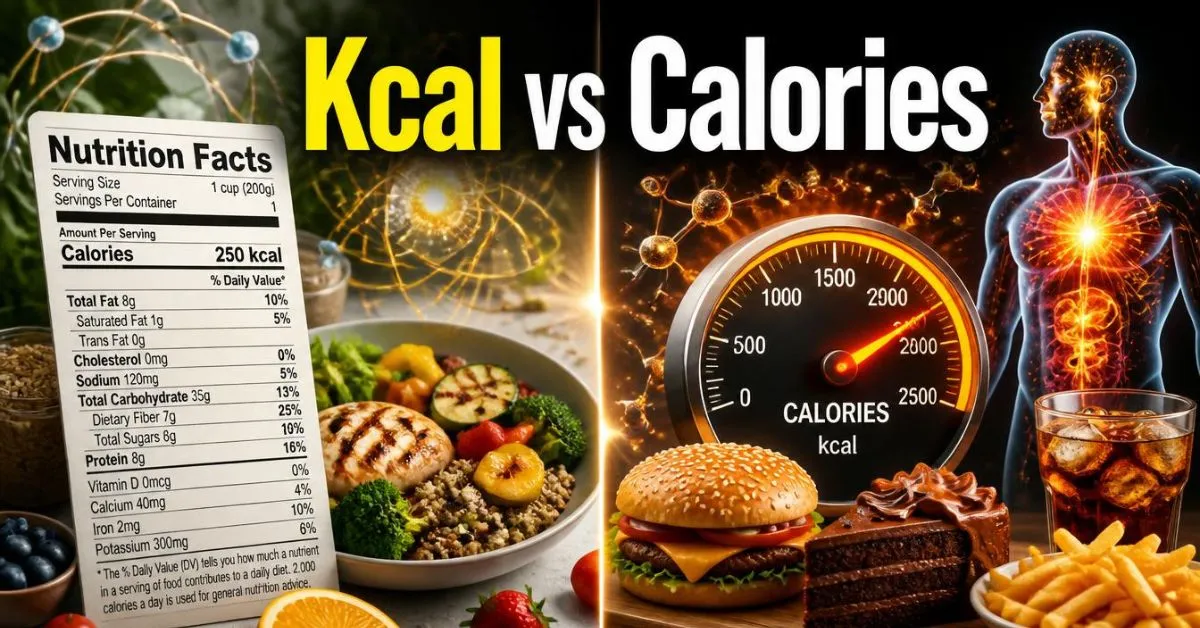
Kcal and food Calories represent the same amount of energy. In nutrition, 1 kilocalorie (kcal) equals 1 food Calorie. Technically, however, 1 kcal equals 1,000 small calories (cal).
So, if a food contains 250 kcal, that is the same as 250 Calories on a typical U.S. nutrition label.
Key Takeaways
- 1 kcal = 1 food Calorie
- 1 kcal = 1,000 small calories (cal)
- Food labels commonly use Calories to describe food energy.
- Nutrition apps may use kcal instead of Calories.
- You usually do not need to convert kcal to food Calories.
- kcal and kJ are different units and do require conversion.
What Does Kcal Mean?
Kcal stands for kilocalorie.
The prefix kilo- means 1,000, so:
1 kcal = 1,000 cal
Here, “cal” refers to the small scientific calorie.
In nutrition, however, kilocalories are the unit commonly used to describe the energy supplied by food and beverages. This is why nutrition apps, diet plans, and scientific resources may list energy in kcal.
For example:
- 100 kcal = 100 food Calories
- 250 kcal = 250 food Calories
- 500 kcal = 500 food Calories
What Does Calorie Mean?
The word calorie can be confusing because it can refer to two different units.
A small calorie (cal) is a scientific unit of energy. A food Calorie, written with a capital C, is equal to one kilocalorie.
So:
1 Calorie = 1 kcal = 1,000 cal
In everyday nutrition conversations, when someone says they ate “2,000 calories,” they normally mean 2,000 food Calories, or 2,000 kcal.
Calorie vs calorie: Why Capitalization Matters
Capitalization can help explain the difference between the two terms.
- cal = small calorie
- Calorie = food Calorie
- kcal = kilocalorie
- 1 Calorie = 1 kcal = 1,000 cal
This is why saying “a food contains 500 calories” does not normally mean 500 small calories. In nutrition, 500 calories usually means 500 Calories, which equals 500 kcal.
Kcal vs Calories: What Is the Difference?
The difference is mostly about terminology and scientific precision.
| Term | Meaning | Food-energy equivalent |
|---|---|---|
| cal | Small calorie | 1/1,000 kcal |
| kcal | Kilocalorie | 1 food Calorie |
| Calorie | Food Calorie | 1 kcal |
| calories | Common nutrition term | Usually kcal |
The most important rule is:
1 kcal = 1 food Calorie
The confusion happens because the lowercase calorie and the nutrition Calorie are technically different units.
Is 1 Kcal the Same as 1 Calorie?
Yes, when “calorie” means a food Calorie.
For nutrition and food tracking:
1 kcal = 1 Calorie
But:
1 kcal = 1,000 small calories
So if your nutrition app says you consumed 1,800 kcal, that represents the same food energy as 1,800 Calories.
You should not multiply 1,800 kcal by 1,000 when tracking food. That conversion would give you 1,800,000 small calories, not 1,800 food Calories.
How Many Calories Are in 1 Kcal?
1 kcal equals 1 food Calorie.
Here are some common examples:
| Kcal | Food Calories | Small Calories |
|---|---|---|
| 50 kcal | 50 Calories | 50,000 cal |
| 100 kcal | 100 Calories | 100,000 cal |
| 250 kcal | 250 Calories | 250,000 cal |
| 500 kcal | 500 Calories | 500,000 cal |
| 1,000 kcal | 1,000 Calories | 1,000,000 cal |
Kcal Conversion Formula
To convert kcal to small calories:
kcal × 1,000 = cal
For example:
250 kcal × 1,000 = 250,000 cal
To convert small calories to kcal:
cal ÷ 1,000 = kcal
However, you do not need this conversion when comparing kcal with food Calories because:
1 kcal = 1 food Calorie
Why Do Nutrition Labels Use Calories?
U.S. Nutrition Facts labels use Calories to show how much energy a serving of food provides. The amount applies to the listed serving size, so checking the serving information is important when calculating how much energy you actually consume.
For example, suppose a cereal label says:
Serving size: 1 cup
Calories: 220
That means one serving provides 220 Calories, or 220 kcal.
If you eat two servings:
220 × 2 = 440 Calories
So your total is 440 Calories, or 440 kcal.
The important point is that the Calories listed on the package are already food Calories. You do not multiply them by 1,000.
Kcal vs Calories vs kJ
Kcal and kJ are both energy units, but they are not the same unit.
- kcal = kilocalorie
- kJ = kilojoule
A commonly used conversion is:
1 kcal ≈ 4.184 kJ
Examples:
| Kcal | Approximate kJ |
|---|---|
| 50 kcal | 209.2 kJ |
| 100 kcal | 418.4 kJ |
| 200 kcal | 836.8 kJ |
| 300 kcal | 1,255.2 kJ |
| 500 kcal | 2,092 kJ |
This conversion is useful when comparing nutrition information that uses different energy units.
Do You Need to Convert Kcal to Calories?
Usually, no.
If your food-tracking app says:
1,800 kcal
you can treat that as:
1,800 food Calories
There is no additional conversion needed.
You only need to convert the number when switching to a genuinely different unit, such as kcal to kJ or small calories to kcal.
Common Kcal & Calorie Mistakes
Mistake 1: Thinking 1 kcal equals 1,000 food Calories
This is incorrect.
1 kcal = 1,000 small calories,
but:
1 kcal = 1 food Calorie
That distinction is the key to understanding kcal vs Calories.
Mistake 2: Multiplying food-label Calories by 1,000
If a package says:
300 Calories
that means approximately:
300 kcal
It does not mean 300,000 food Calories.
Mistake 3: Ignoring serving size
A label might list:
150 Calories per serving
but the package could contain three servings.
If you eat the entire package:
150 × 3 = 450 Calories
Always check the serving size before calculating your total intake.
Mistake 4: Confusing kcal with kJ
Kcal and kJ both measure energy, but they use different units.
1 kcal ≈ 4.184 kJ
So 500 kcal is not the same numerical value as 500 kJ.
Why Is Kcal Used Instead of Small Calories?
Food contains relatively large amounts of energy, so using small calories would produce unnecessarily large numbers.
For example:
500 kcal = 500,000 cal
Writing 500 kcal is much simpler than writing 500,000 cal.
That is one reason kilocalories are commonly used when describing food energy.
Kcal vs Calories: Which One Should You Use?
For everyday food tracking, either term is usually fine when calories means food Calories.
You may see:
- Calories on U.S. nutrition labels
- kcal in nutrition apps
- kcal in scientific or nutrition-related information
- kJ on labels or resources that use the metric energy unit
The number does not automatically become 1,000 times larger just because one source says kcal and another says Calories.
For example:
200 kcal = 200 Calories
FAQs:
Is 100 kcal the same as 100 calories?
Yes, when “calories” means food Calories. In nutrition, 100 kcal equals 100 Calories. Technically, 100 kcal equals 100,000 small calories.
Is kcal higher than a calorie?
A kilocalorie is 1,000 times larger than a small calorie. However, one food Calorie is already equal to one kilocalorie. So 100 kcal and 100 food Calories represent the same amount of energy.
What does kcal stand for?
Kcal stands for kilocalorie. One kilocalorie equals 1,000 small calories. In nutrition, kcal is commonly used to describe the energy provided by food and beverages.
Why do some apps say kcal instead of calories?
Nutrition apps may use kcal because it is a precise unit for measuring food energy. Other apps and everyday conversations use calories because the term is more familiar. When discussing food, the two generally represent the same energy amount.
Is kcal the same as kJ?
No. Kcal and kJ are different units of energy. One kcal is approximately equal to 4.184 kJ, so you need to convert the value when switching between them.
Should I multiply Calories by 1,000?
No, not when you’re reading a food label or tracking food. A nutrition label showing 300 Calories is referring to 300 food Calories, which equals 300 kcal. Multiplying it by 1,000 would convert it to small calories instead.
Conclusion:
Understanding kcal vs Calories is easier once you separate the scientific calorie from the food Calorie.
The main rule to remember is:
1 kcal = 1 food Calorie
Technically:
1 kcal = 1,000 small calories
So if a nutrition app lists 200 kcal and a U.S. food label lists 200 Calories, they represent the same amount of food energy.
The main thing to check when reading a nutrition label is the serving size, not whether the number is written as kcal or Calories. Serving size tells you how much of the listed energy applies to the amount of food you actually eat.