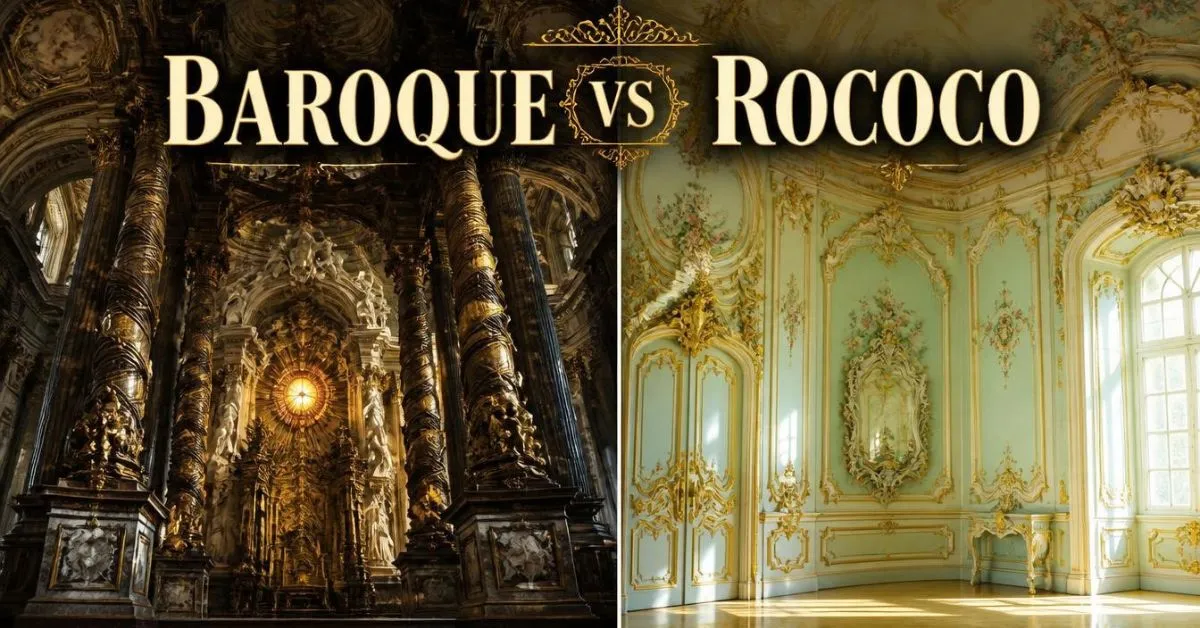
Baroque vs Rococo mainly comes down to mood, scale, purpose, and decoration. Baroque is generally dramatic, monumental, emotional, and theatrical, while Rococo is lighter, more intimate, playful, and delicate.
Baroque developed earlier in Europe, while Rococo emerged in early 18th-century France and became especially influential in interiors and decorative arts.
Key Takeaways
- Baroque came first, becoming influential in Europe during the 17th century and early 18th century.
- Rococo developed later, emerging in France around the early 18th century.
- Baroque favors drama, movement, grandeur, emotion, and theatrical effects.
- Rococo favors lightness, intimacy, asymmetry, pastel colors, shells, flowers, and playful subjects.
- Rococo grew from the Baroque tradition but developed a distinct visual language of its own.
What Is the Difference Between Baroque & Rococo?
The simplest way to remember Baroque vs Rococo is this:
Baroque aims to impress. Rococo aims to charm.
Baroque emerged in Italy and spread throughout Europe during the 17th century. It brought painting, sculpture, architecture, and design together to create dramatic visual experiences. Its movement, emotion, rich decoration, and theatrical effects were particularly useful in religious, royal, and aristocratic settings.
Rococo appeared later, particularly in France during the early 18th century. It began strongly in the decorative arts and became associated with elegant interiors, furniture, ceramics, painting, and other forms of design. Its decoration often uses flowing asymmetrical curves, shells, flowers, foliage, pastel colors, and delicate gilding.
So if Baroque feels grand, powerful, and dramatic, Rococo usually feels light, elegant, playful, and intimate.
Baroque vs Rococo at a Glance
| Feature | Baroque | Rococo |
| Developed | Earlier | Later |
| Major early center | Italy, especially Rome | France, especially Paris |
| General period | 17th to early 18th century | Early to mid-18th century |
| Mood | Dramatic and powerful | Light and playful |
| Scale | Often monumental | Often intimate |
| Purpose | Religious, royal, political, public | Aristocratic, social, private, decorative |
| Composition | Dynamic and theatrical | Flowing and often asymmetrical |
| Colors | Rich, contrasting, dramatic | Pastel, light, soft, often white and gold |
| Ornament | Grand and integrated with architecture | Delicate and highly decorative |
| Common motifs | Columns, dramatic curves, sculpture, gilding | Shells, flowers, leaves, scrolls, mirrors |
| Typical feeling | Awe and grandeur | Elegance and pleasure |
These are broad characteristics rather than strict rules. Art movements changed across countries, artists, and mediums, so individual works may combine features from both traditions.
What Is Baroque Art?
Baroque art is known for movement, emotion, drama, and visual impact.
The style developed in Italy and became widespread across Europe. Baroque artists often wanted viewers to feel emotionally involved in what they were seeing. Strong contrasts of light and shadow, energetic poses, dramatic gestures, and carefully staged compositions helped create that effect.
Baroque also frequently brought different art forms together. A church, for example, might combine architecture, sculpture, painting, light, and decorative elements into one carefully planned experience.
Common Baroque Characteristics
Look for:
- Dramatic movement
- Strong emotion
- Theatrical compositions
- Light and shadow
- Monumental scale
- Rich ornament
- Strong visual contrasts
- Religious and historical subjects
- Royal and aristocratic imagery
- Elaborate architecture
The goal was often not simply to make something beautiful. Baroque art could also communicate religious devotion, authority, wealth, or power.
What Is Rococo Art?
Rococo developed later and created a noticeably different mood.
The National Gallery of Art describes Rococo as a light-hearted style that emerged in France around 1700. It became especially prominent in decorative arts and favored pastel colors and natural forms such as flowers and shells. Rococo painters also explored intimate mythological scenes, portraits, and everyday life.
The name itself comes from the French rocaille, referring to rock and shell decoration. Shell-like forms became an important part of Rococo ornament.
Common Rococo Characteristics
Look for:
- Pastel colors
- Light and airy compositions
- Asymmetrical decoration
- Shell motifs
- Flowers and foliage
- Curved S- and C-shaped forms
- Mirrors and gilding
- Romantic subjects
- Leisure and social scenes
- Intimate interiors
Rococo decoration can actually be extremely elaborate. Its difference from Baroque is less about having more or less decoration and more about the type, scale, mood, and visual effect of that decoration.
Baroque vs Rococo in Painting
Painting provides one of the clearest ways to see the difference.
Baroque Painting
Baroque painters often created scenes filled with tension and action. Figures may twist, gesture, struggle, or look directly toward an important event.
Lighting can be equally dramatic. Strong contrasts between light and darkness help guide the viewer’s attention and increase emotional intensity.
Religious stories, historical events, mythology, portraits, and scenes of power were all important subjects.
Caravaggio, for example, became famous for dramatic lighting and emotionally intense scenes. Peter Paul Rubens, Artemisia Gentileschi, Diego Velázquez, and Rembrandt are also major artists associated with the broader Baroque period.
Rococo Painting
Rococo painting usually moves away from that heavy sense of drama.
Instead, artists often explored romance, leisure, music, gardens, fashion, mythology, and aristocratic social life.
Important French Rococo artists include Jean-Antoine Watteau, François Boucher, and Jean-Honoré Fragonard. Their works often emphasize elegant figures, graceful movement, decorative settings, and playful or romantic themes.
A useful shortcut is:
Baroque painting often asks, “Can you feel the drama?”
Rococo painting often asks, “Can you enjoy the scene?”
Baroque vs Rococo Architecture
Architecture makes the comparison more complicated because Rococo was not simply a new version of Baroque architecture.
Baroque architecture often uses monumental scale, dramatic spatial effects, strong axes, curved forms, domes, theatrical light, and an integration of architecture with painting and sculpture.
Rococo became especially important in interior decoration and the decorative arts. It favored delicate stucco, mirrors, carved ornament, shells, flowers, asymmetrical curves, and light colors. The V&A notes that early Rococo was developed particularly by craftspeople and designers and was prominent in furniture, silver, and ceramics.
A Simple Architecture Test
When looking at an ornate European interior, ask:
Does it feel monumental and theatrical?
That points toward Baroque.
Does it feel intimate, light, delicate, and highly ornamental?
That points toward Rococo.
However, don’t identify a building from decoration alone. Date, country, building type, later renovations, and individual rooms all matter.
Baroque vs Rococo: Color & Decoration
Color is one of the fastest visual clues, although it should never be the only test.
Baroque interiors and artworks can use rich colors, strong contrasts, dark shadows, marble, and extensive gilding. The overall effect can feel powerful and theatrical.
Rococo commonly uses pastels, white, cream, pale blue, soft pink, gold, and other light tones.
Decoration also changes character.
Baroque ornament tends to reinforce a larger architectural or dramatic composition. Rococo ornament often appears to flow across surfaces through shells, foliage, flowers, scrolls, and asymmetrical curves.
One important point: Rococo is not simply “less ornate” than Baroque. In some interiors, Rococo can be just as elaborate or even more densely decorative but its ornament usually feels lighter and more playful.
How to Tell Baroque and Rococo Apart
If you need to identify a style quickly, use this five-question test.
1. Is the overall mood dramatic or playful?
Dramatic = Baroque
Playful or relaxed = Rococo
2. Does the space feel monumental or intimate?
A huge ceremonial church or palace designed to create awe is more likely to have a Baroque character.
A smaller salon or richly decorated private room is more likely to show Rococo influence.
3. What kind of ornament do you see?
Look for grand architectural forms, sculpture, columns, and dramatic curves in Baroque work.
Look for shells, flowers, foliage, mirrors, and delicate asymmetrical scrollwork in Rococo work.
4. What is the color palette?
Dark, rich, or strongly contrasting colors can suggest Baroque.
Pastels, white, and gold often suggest Rococo.
But remember: color is a clue, not proof.
5. What does the artwork want you to feel?
Baroque often seeks awe, emotion, tension, or grandeur.
Rococo more often seeks pleasure, elegance, romance, or amusement.
Why Did Rococo Develop After Baroque?
Rococo developed from the artistic world created by Baroque, but social and cultural preferences were changing.
The V&A describes Rococo as the final expression of the Baroque movement while also emphasizing its distinctive ornamental language. Rococo emerged in France during the 1720s and 1730s and was particularly strong in furniture, silver, ceramics, and interior decoration.
As aristocratic life increasingly centered on more intimate social spaces, the monumental visual language of Baroque could be adapted into something lighter and more private.
This is why the transition should not be imagined as:
Baroque ends → Rococo suddenly begins.
It was more gradual:
Baroque → Late Baroque developments → Rococo
Different countries also moved through these styles at different speeds.
Is Rococo Just Late Baroque?
Rococo is closely related to Baroque, but it is not simply the same style.
The V&A describes Rococo as a final expression of the Baroque movement, which explains why historians sometimes discuss the two together.
At the same time, Rococo developed recognizable characteristics of its own, including asymmetrical ornament, pastel colors, shell and floral motifs, intimate interiors, and lighter subject matter.
So the most accurate answer is:
Rococo grew out of the Baroque tradition but became a distinct style.
Famous Baroque & Rococo Examples
Specific examples make the difference easier to remember.
Baroque Examples
- Gian Lorenzo Bernini Ecstasy of Saint Teresa
- Caravaggio The Calling of Saint Matthew
- Peter Paul Rubens dramatic mythological and religious compositions
- Francesco Borromini innovative Baroque architecture in Rome
Bernini and Borromini are especially important for understanding the dramatic spatial character of Roman Baroque architecture.
Rococo Examples
- Jean-Antoine Watteau Pilgrimage to Cythera
- François Boucher romantic and mythological scenes
- Jean-Honoré Fragonard The Swing
- Rococo interiors rooms featuring shells, flowers, mirrors, gilding, and asymmetrical ornament
These examples show that Rococo was not limited to painting. It influenced furniture, ceramics, silver, textiles, interiors, and other decorative arts.
Which Came First, Baroque or Rococo?
Baroque came first. It emerged in Italy around the beginning of the 17th century and spread across Europe. Rococo developed later, particularly in France during the early 18th century. Because the styles overlap chronologically, the transition between them was gradual rather than absolute.
Is Versailles Baroque or Rococo?
Versailles is primarily associated with French Baroque and the grand royal culture of Louis XIV. Its monumental architecture, formal planning, ceremonial spaces, and theatrical decoration fit the Baroque tradition.
However, later French interiors and decorative arts developed Rococo characteristics, particularly during the reign of Louis XV. This is why it is better to identify a specific room, object, or period instead of labeling everything connected with Versailles simply as Rococo or Baroque.
What Replaced Rococo?
Neoclassicism gradually replaced Rococo as the dominant fashion in many European artistic circles.
Neoclassical artists and designers looked toward ancient Greece and Rome and favored greater order, clarity, restraint, and classical forms. Rococo’s playful ornament eventually came to seem too frivolous for changing intellectual and cultural tastes.
The shift was gradual rather than sudden, and Rococo continued to influence decorative arts even after Neoclassical ideas became popular.
Is Rococo More Decorative Than Baroque?
Rococo can be extremely decorative, but its decoration is usually lighter and more delicate than Baroque ornament.
Baroque decoration often contributes to a larger dramatic composition involving architecture, sculpture, painting, light, and space. Rococo decoration tends to emphasize surfaces and interiors through shells, flowers, foliage, mirrors, curves, and intricate asymmetrical patterns.
So the better distinction is not more decoration vs less decoration.
It is:
Baroque = dramatic decoration
Rococo = delicate, playful decoration
FAQs:
What is the easiest way to remember Baroque vs Rococo?
Think grand vs intimate. Baroque is generally dramatic, monumental, emotional, and theatrical. Rococo is generally lighter, more playful, delicate, and intimate. This shortcut is useful, but individual works can combine characteristics from both styles.
What is the main difference between Baroque and Rococo architecture?
Baroque architecture tends to emphasize monumental scale, dramatic spatial movement, strong axes, curves, and theatrical effects. Rococo is especially associated with ornate interiors featuring asymmetry, shells, flowers, mirrors, delicate curves, and lighter colors.
Is Rococo more feminine than Baroque?
Rococo has historically been described as more delicate, elegant, and associated with aristocratic leisure, but calling it simply “feminine” can oversimplify the style. Its defining characteristics are better understood through its ornament, asymmetry, color, subject matter, and intimate scale.
Did Rococo come from France?
Yes, Rococo is strongly associated with France, where it emerged in the early 18th century. It later spread to other parts of Europe and developed different forms in different regions.
Conclusion:
The easiest way to understand Baroque vs Rococo is to look beyond the fact that both styles can be highly ornate. Their real difference lies in how that ornament is used and what experience it creates.
Baroque is typically dramatic, monumental, emotional, theatrical, and powerful. It often connects art, architecture, sculpture, light, and space to create a strong visual impact. Rococo developed later and transformed many of those decorative ideas into something lighter, more intimate, playful, asymmetrical, and elegant.
If you see massive architectural forms, dramatic movement, intense emotion, and a sense of grandeur, think Baroque. If you see pastel colors, shells, flowers, delicate curves, mirrors, and playful scenes, think Rococo.
The two styles are closely connected, but they are not identical. Baroque wants to impress you; Rococo wants to delight you. That simple distinction makes it much easier to recognize the difference while still leaving room for the historical overlap between them.

Olivia Smith is a professional author at ReplyGenius.com, where I create clear and engaging content on communication and writing.