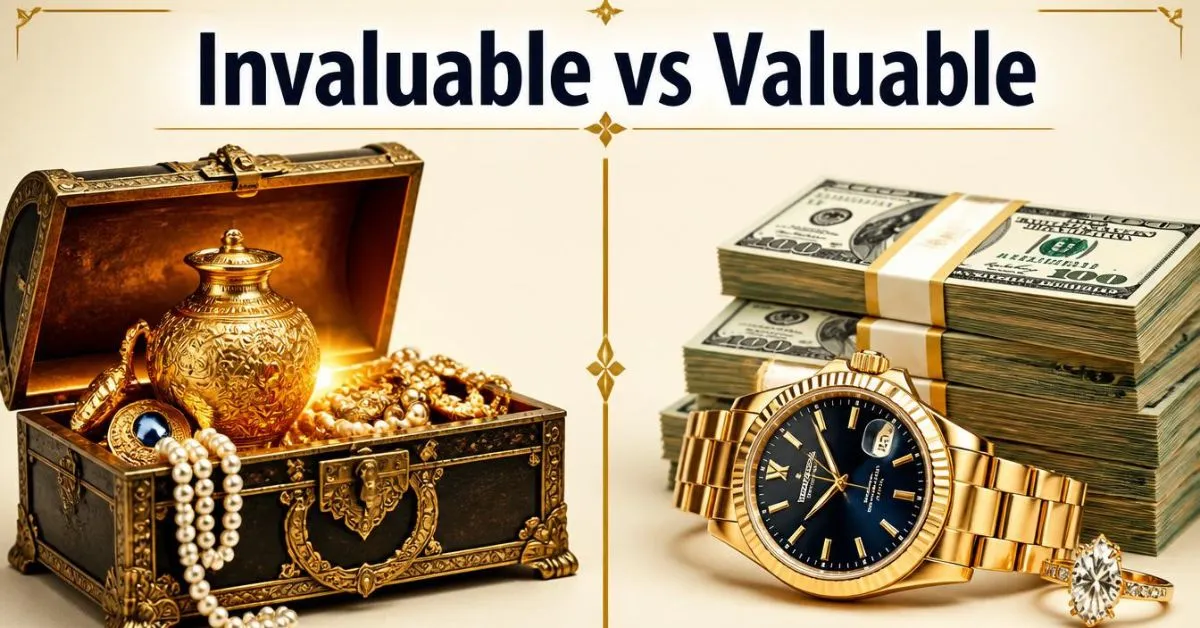
Valuable and invaluable both describe worth, but they have slightly different meanings. Valuable means worth a lot of money, useful, or important. Invaluable means extremely useful or important.
For example, a rare watch may be valuable because of its price. A mentor’s advice may be invaluable because it helps you make a hard choice.
The main difference is the focus. Use valuable for money, use, or importance. Use invaluable when you want to stress how much something helps or matters.
Key Takeaways
- Valuable means worth a lot of money, useful, or important.
- Invaluable means extremely useful or important.
- Invaluable does not mean worthless.
- Both words can describe advice, skills, time, support, and knowledge.
- Use valuable to describe general worth.
- Use invaluable to stress the great value of help or knowledge.
- The best word depends on what you want to say.
What Does Valuable Mean?
Valuable is an adjective. It describes something that has a high price, is useful, or is important.
For example, a diamond may be valuable because it costs a lot of money. A lesson can also be valuable because it teaches you something useful.
Valuable does not only refer to money. It can describe time, skills, advice, and many other things.
Examples of Valuable in a Sentence
- This painting is valuable because it is rare.
- She gave me valuable advice about my career.
- Time is valuable, so I try not to waste it.
- The team collected valuable data for its report.
- He has valuable skills that help the company.
- This book offers valuable lessons for new writers.
- The museum protects valuable old objects.
- Her feedback was valuable to the whole team.
These examples show three common uses of valuable: money worth, usefulness, and importance.
When Should You Use Valuable?
Use valuable when you want to show that something has worth or gives a benefit.
- Money: This ring is valuable.
- Knowledge: This guide contains valuable information.
- Time: Every hour is valuable.
- Work: She is a valuable member of the team.
- Experience: The job gave me valuable experience.
Valuable works well in daily speech, schoolwork, business writing, and formal documents.
What Does Invaluable Mean?
Invaluable is an adjective that means extremely useful or important. It often describes something that helps so much that its worth is hard to measure.
For example, a teacher’s support may be invaluable to a student who is having trouble. Old records may also be invaluable to a researcher because they hold facts that are hard to find elsewhere.
Cambridge defines invaluable as extremely useful. Oxford also explains that it means very useful or valuable. Both sources make clear that invaluable does not mean worthless.
Examples of Invaluable in a Sentence
- Her advice was invaluable during my job search.
- The training gave me invaluable work experience.
- His support was invaluable during a hard time.
- This guide is an invaluable resource for students.
- The records proved invaluable to the researchers.
- My parents’ help has been invaluable to me.
- Her experience was invaluable during the project.
- The old letters were invaluable to the historian.
In each sentence, invaluable stresses how much the advice, support, or information matters.
When Should You Use Invaluable?
Use invaluable when you want to stress the great value of something.
- Advice: Her advice was invaluable to me.
- Research: The records proved invaluable to the team.
- Education: This book is an invaluable resource for students.
- Work: His experience was invaluable during the project.
- Personal support: Your help was invaluable when I needed it most.
Invaluable is common when talking about help, guidance, experience, information, and resources.
Invaluable vs Valuable: Key Differences
| Feature | Valuable | Invaluable |
|---|---|---|
| Main meaning | Worth a lot of money, useful, or important | Extremely useful or important |
| Money | Common when an item has a high price | Can describe something precious, but often stresses its use or importance |
| Advice | Useful or important advice | Advice that helps a great deal |
| Experience | Experience that gives a benefit | Experience that proves very useful |
| Common phrases | Valuable time, valuable skills, valuable data | Invaluable advice, invaluable support, invaluable resource |
| Similar words | Useful, worthwhile, precious | Extremely useful, priceless in some contexts |
| Opposite | Worthless or valueless, depending on the meaning | Useless or unhelpful in some contexts |
The meanings overlap. Valuable advice can be very helpful, and invaluable advice can also be very helpful. Invaluable puts more stress on how much something matters, but it is not always the better word.
Is Invaluable the Opposite of Valuable?
No. Invaluable does not mean worthless. It means extremely useful or important.
The word can be confusing because the prefix in- often means not, as in inactive or incorrect. But you cannot work out the meaning of invaluable from the prefix alone.
Compare these examples:
- Valuable: The painting is valuable because it is rare.
- Invaluable: The painting gave historians invaluable clues about the past.
- Worthless: The damaged copy had little or no market value.
The first sentence focuses on price. The second focuses on the importance of the clues. The third says the copy has little or no worth in that case.
Oxford lists worthless and valueless as opposites of valuable. It also marks invaluable as a different word, not its opposite.
Invaluable vs Valuable: Which Word Fits Each Situation?
The best choice depends on what you want to say.
1. Money and Expensive Objects
Use valuable when you mean an item has a high price or market value.
Example: This antique watch is valuable.
You can also use invaluable when you mean an item has great importance to someone.
Example: This rare collection is invaluable to the museum.
The first sentence focuses on price. The second focuses on the collection’s importance to the museum.
2. Advice & Help
Both words work when you describe advice or help.
- Your advice was valuable.
- Your advice was invaluable.
The first says the advice was useful or important. The second stresses how much it helped. Both sentences are correct.
3. School & Learning
Use valuable for lessons, skills, and facts that help you learn. Use invaluable when you want to stress how much that help matters.
- The course taught me valuable skills.
- My tutor’s guidance was invaluable before the exam.
4. Business & Work
Both words are common in the workplace.
- She is a valuable member of our team.
- His knowledge was invaluable during the project.
The first describes her role in the team. The second stresses how much his knowledge helped.
5. Family & Personal Meaning
Use valuable for things that matter to you. Use invaluable when you want to stress the great help or support someone gave you.
- These photos are valuable to me.
- My family’s support was invaluable during that time.
For things with deep personal meaning, priceless or irreplaceable may also fit.
Valuable vs Invaluable: Common Grammar Patterns
Both words are adjectives. They often appear with the prepositions to and for.
| Pattern | Example |
|---|---|
| Valuable to someone | Her feedback was valuable to the team. |
| Valuable for a purpose | This tool is valuable for learning new skills. |
| Invaluable to someone | His help was invaluable to us. |
| Invaluable for a purpose | This guide is invaluable for new teachers. |
| Invaluable in a situation | Her experience proved invaluable in a crisis. |
| An invaluable resource | The library is an invaluable resource for students. |
These patterns work in emails, school assignments, reports, and work messages. Choose the preposition that fits the full sentence.
Invaluable vs Valuable vs Priceless
These three words are related, but each has a different focus.
| Word | Main meaning | Example |
|---|---|---|
| Valuable | Has a high price, use, or importance | This painting is valuable. |
| Invaluable | Extremely useful or important | Her advice was invaluable. |
| Priceless | Too precious to measure by money; also used for something very funny | These family photos are priceless. |
Use valuable for general worth. Use invaluable to stress how much something helps or matters. Use priceless when something is so special that money cannot show its worth.
The meanings can overlap, so context matters more than a fixed ranking.
Common Mistakes to Avoid
Mistake 1: Thinking Invaluable Means Worthless
Wrong: Invaluable means something has no value.
Right: Invaluable means extremely useful or important.
Example: Her help was invaluable during the emergency.
Mistake 2: Using Invaluable Only for Expensive Things
Invaluable can describe objects, but it is also common for advice, skills, support, and knowledge.
Example: The report gave us invaluable information.
Mistake 3: Assuming Invaluable Is Always Better
Invaluable is not always the best choice. If you mean that a car has a high price, valuable is clearer. If you mean someone’s help made a big difference, invaluable may fit better.
Mistake 4: Treating the Words as Exact Synonyms
The words share some meanings, but they can stress different things. Choose the word that best matches your meaning.
Quick Test: Valuable or Invaluable?
Choose the word that best fits each sentence.
- The rare coin is worth thousands of dollars. It is.
- Her guidance helped us solve a hard problem. It was.
- The report gives us useful facts for our research. It provides information.
Answers
- Valuable
- Invaluable
- Valuable or invaluable, depending on how much the facts matter to the research.
The third answer can be either word. Context decides which one fits best.
FAQs:
Does invaluable mean priceless?
Often, the meanings are close. Invaluable means extremely useful or important. Priceless often means too precious to measure by money, especially when something has great personal or special value.
Can a person be invaluable?
Yes. You can call someone invaluable when their skills, knowledge, or work is very important.
Example: Our lead engineer was invaluable during the project.
Is valuable a positive word?
Yes. Valuable usually describes something that has worth, use, or importance.
What is the opposite of invaluable?
There is no single opposite for every case. Useless or unhelpful may fit when you mean a lack of use. Worthless may fit when you mean a lack of worth. Valuable is not the opposite of invaluable.
Which is correct: invaluable experience or valuable experience?
Both are correct. Valuable experience gives you useful skills or knowledge. Invaluable experience stresses how much that experience helps or matters.
Can I use invaluable in formal writing?
Yes. Invaluable is common in work, school, and formal writing.
Example: The findings gave us invaluable insight into the problem.
Conclusion:
Valuable and invaluable both describe worth, but they often stress different things. Valuable can mean that something costs a lot, is useful, or is important. Invaluable means that something is extremely useful or important.
Use valuable for costly items, time, skills, and useful facts. Use invaluable for advice, support, experience, or resources that make a big difference.
Most of all, remember that invaluable does not mean worthless. Choose the word that best expresses your meaning. Neither word is always better than the other.

Olivia Smith is a professional author at ReplyGenius.com, where I create clear and engaging content on communication and writing.