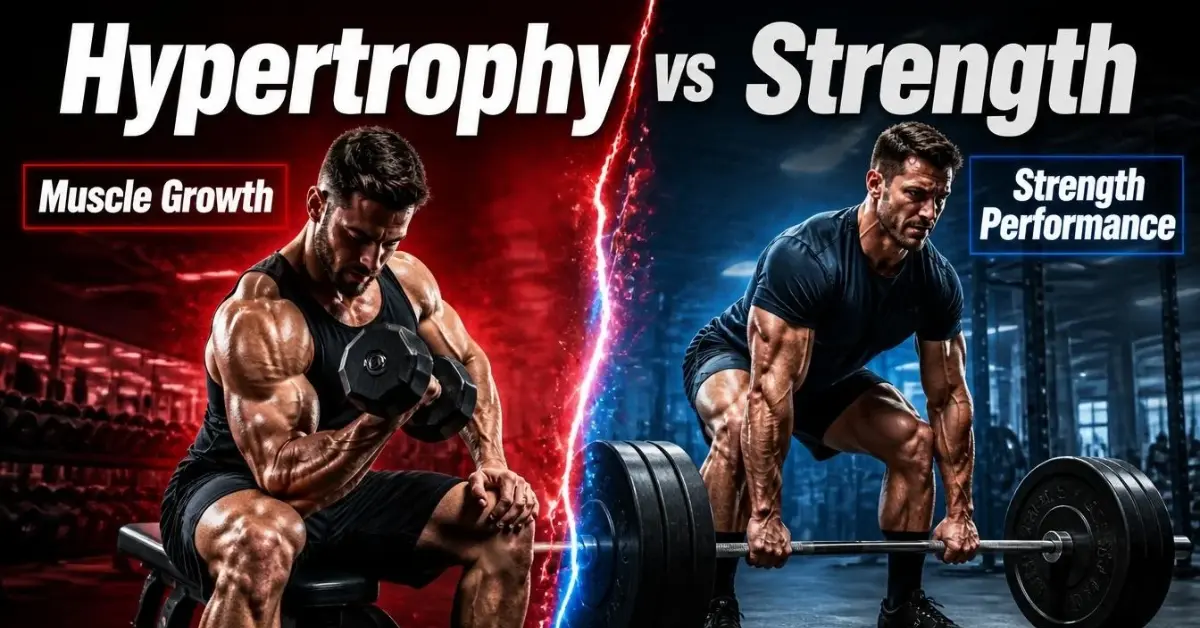
Hypertrophy vs Strength refers to two different goals of resistance training. Hypertrophy focuses on increasing muscle size, while strength training focuses on improving the amount of force muscles can produce.
Although both involve resistance exercises, they create different training adaptations. The good news is that muscle growth and strength development can happen together.
Key Takeaways
- Hypertrophy focuses on increasing muscle size through muscle growth and adaptation.
- Strength focuses on improving the body’s ability to produce force.
- Both goals involve resistance training, progressive overload, and proper recovery.
- Larger muscles can have greater strength potential, but muscle size does not determine strength by itself.
- You can improve muscle size and strength through the same general resistance-training approach.
What Is Muscle Hypertrophy?
Muscle hypertrophy is the increase in the size of muscle fibers. It happens when muscles adapt to repeated resistance-training demands over time.
When someone performs resistance exercises, their muscles experience mechanical tension. This creates signals that support muscle repair and growth. With consistent training, adequate nutrition, and enough recovery, muscle fibers can increase in size.
Hypertrophy is commonly associated with bodybuilding and muscle-building programs. However, it is not limited to bodybuilders. It is also a natural adaptation that can occur through regular resistance training.
How Muscle Hypertrophy Works
Muscle growth involves several biological processes. Mechanical tension plays an important role because muscles must produce force against resistance.
Other factors, including training volume, exercise selection, nutrition, and recovery, also influence the process.
Progressive resistance training helps muscles adapt to gradually changing demands. However, progress does not require constantly increasing the weight or making every workout more difficult.
The goal is to provide an appropriate training stimulus while allowing the body enough time to recover.
Benefits of Muscle Hypertrophy
Muscle hypertrophy offers several benefits beyond changes in muscle size.
- Muscular development: It supports the growth and development of skeletal muscle.
- Physical function: Healthy muscle tissue helps support everyday movements.
- Training capacity: Developing muscle can contribute to improved physical performance.
- Long-term fitness: Resistance training supports overall muscular health.
Hypertrophy is therefore about more than appearance. It is an important part of physical development and muscular function.
What Is Strength Training?
Strength training focuses on improving the muscles’ ability to produce force against resistance.
In simple terms, strength describes how much force a person can generate during a physical activity. It is useful for everyday movements, sports, and other activities that require muscular effort.
Strength training commonly involves exercises such as squats, presses, rows, and other resistance movements. These exercises challenge the muscles and nervous system, helping the body become more efficient at producing force.
Unlike hypertrophy, which primarily focuses on muscle size, strength training places greater emphasis on performance.
How Strength Develops
Strength improvements involve more than muscle growth.
The nervous system plays an important role in controlling muscle contractions. As someone gains experience with resistance exercises, the brain and nervous system can become more efficient at recruiting muscle fibers and coordinating movements.
This is one reason a person can become stronger without experiencing a large increase in muscle size.
Strength also depends on factors such as:
- Muscle size and structure
- Nervous system adaptations
- Exercise technique
- Movement coordination
- Training experience
- Physical recovery
These factors work together to influence how effectively someone produces force.
Benefits of Strength Training
Strength development offers several practical benefits.
- Everyday movement: Greater muscular strength supports activities such as carrying objects and climbing stairs.
- Physical performance: Strength contributes to performance in many sports and physical activities.
- Functional fitness: Strong muscles help support balance, stability, and movement.
- Muscular health: Resistance training helps maintain muscle function throughout life.
Strength training is not only for athletes. It can also support general health and physical independence.
Hypertrophy vs Strength: Key Differences
The main difference between hypertrophy and strength is the adaptation being emphasized.
Hypertrophy focuses on increasing muscle size, whereas strength training emphasizes improving force production and physical performance.
However, the two are closely connected. Muscle size contributes to strength potential, and strength training can also stimulate muscle growth.
Here is a comparison of their main characteristics.
| Feature | Hypertrophy | Strength |
| Primary goal | Increase muscle size | Improve force production |
| Main adaptation | Muscle fiber growth | Muscular and nervous system adaptations |
| Common association | Bodybuilding | Strength sports and athletic performance |
| Important factor | Training volume | Appropriate resistance and technique |
| Performance focus | Muscular development | Producing greater force |
| Main training method | Progressive resistance training | Progressive resistance training |
Muscle Size vs Force Production
Muscle size and muscular strength are related, but they are not the same thing.
A larger muscle generally has greater potential to produce force because it contains more contractile tissue. However, actual strength also depends on nervous system efficiency, movement technique, muscle coordination, and other individual factors.
For example, consider two people performing the same resistance exercise.
One person may have larger muscles, while the other has more experience with that particular movement. The more experienced person may perform better because their nervous system and technique are more adapted to the exercise.
This explains why muscle size alone cannot determine someone’s strength.
Training Adaptations
Hypertrophy and strength training create overlapping but somewhat different adaptations.
Hypertrophy emphasizes changes in muscle tissue. Strength development involves muscle tissue as well as improvements in how the nervous system controls movement.
Research supports this difference. A 2023 systematic review published in the British Journal of Sports Medicine found that different resistance-training approaches improved both muscle strength and hypertrophy. However, higher-load training ranked particularly well for strength development.
Training Volume and Intensity
Training volume refers to the amount of resistance exercise performed over a period of time. Intensity describes how challenging the resistance is relative to a person’s capacity.
Both variables influence training adaptations.
For muscle hypertrophy, research highlights the importance of appropriate training volume. The 2026 ACSM position stand identified higher weekly training volume as an important factor associated with greater muscle growth.
For strength, heavier resistance and effective movement technique are particularly important factors.
However, there is no universal repetition range that completely separates hypertrophy from strength. Different resistance levels can contribute to both outcomes.
Performance and Recovery
Strength development often involves improving performance in specific movements. Hypertrophy emphasizes the development of muscle tissue.
Despite these differences, recovery is essential for both.
Muscles and the nervous system need time to adapt to exercise demands. Sleep, adequate nutrition, hydration, and appropriate rest all support this process.
Training harder every day does not automatically produce better results. Consistency and recovery matter more than constantly increasing exercise demands.
Can You Build Muscle and Strength Together?
Yes. Muscle growth and strength development are closely connected, and resistance training can improve both at the same time.
In fact, research shows that different resistance-training approaches can produce improvements in both outcomes.
The important distinction is that the degree of improvement may differ depending on the training approach, individual experience, and physical characteristics.
For example, someone who regularly practices resistance exercises may experience improvements in both muscle development and movement performance. Their muscles adapt to exercise demands while their nervous system becomes more efficient at coordinating movements.
A 2023 systematic review found that all examined resistance-training prescriptions improved strength and hypertrophy compared with no exercise. Higher loads were particularly effective for strength outcomes, while multiple-set approaches also supported both adaptations.
For general fitness, it is not necessary to treat muscle growth and strength as completely separate goals.
A balanced approach to physical activity can support muscular development, functional strength, and overall health.
Which Is More Important: Hypertrophy or Strength?
Neither hypertrophy nor strength is universally more important. The better outcome depends on what someone wants to improve.
Hypertrophy is primarily concerned with muscle development, while strength focuses on physical performance and force production.
For example, a competitive strength athlete may prioritize performance in specific lifting movements. Someone interested in general muscular development may place greater emphasis on muscle growth.
However, these goals do not need to compete with each other.
Both are important parts of muscular fitness. Healthy muscle development and strength can support everyday activities, physical performance, and long-term health.
For teenagers, resistance exercise should be appropriate for their age and experience, with qualified supervision, proper technique, and an emphasis on health rather than maximal lifting or rapid physical changes.
Common Misconceptions About Hypertrophy and Strength
Several misunderstandings make it difficult to understand the relationship between muscle size and strength.
Myth 1: Bigger muscles always mean greater strength.
Not necessarily. Muscle size contributes to strength potential, but technique, nervous system adaptations, coordination, and training experience also matter.
Myth 2: Strength training does not build muscle.
Strength-focused resistance exercise can stimulate muscle growth. The amount of growth depends on several factors, including training volume and individual adaptation.
Myth 3: Hypertrophy training cannot improve strength.
This is incorrect. Muscle growth can contribute to greater force-producing capacity. Hypertrophy-focused exercise can also improve muscular strength.
Myth 4: Muscle growth and strength require completely different exercises.
Many exercises support both outcomes. The difference often comes from the overall training emphasis rather than the exercise name alone.
Myth 5: More exercise always means better results.
Recovery is an essential part of physical adaptation. Excessive exercise without adequate rest can negatively affect performance and well-being.
FAQs:
1. What is the difference between hypertrophy and strength?
Hypertrophy refers to an increase in muscle size, while strength refers to the ability to produce force. Both improve through resistance training, but they involve different adaptations. Hypertrophy emphasizes muscle growth, whereas strength development also involves nervous system efficiency, coordination, and exercise technique.
2. Is hypertrophy better than strength training?
Neither is automatically better. Hypertrophy is useful for developing muscle tissue, while strength training improves force production and physical performance. The right emphasis depends on personal fitness goals. Both approaches can support muscular health and general physical fitness.
3. Can you build muscle and strength at the same time?
Yes. Resistance training can improve muscle size and strength simultaneously. These adaptations share several biological processes, including muscle development and improved muscular function. The amount of progress in each area depends on training experience, exercise demands, recovery, and individual differences.
4. Does bigger muscle mean more strength?
Not always. Larger muscles generally have greater force-producing potential, but strength also depends on nervous system function, movement coordination, technique, and training experience. Therefore, someone with smaller muscles may outperform someone with larger muscles in a particular physical activity.
5. Can you be strong without having big muscles?
Yes. Strength depends on several factors beyond muscle size. Nervous system adaptations, coordination, movement efficiency, and exercise experience can improve force production without requiring substantial increases in muscle size. This is why muscular appearance alone is not a reliable measure of physical strength.
Conclusion:
Understanding Hypertrophy vs Strength makes it easier to recognize how different resistance-training goals affect the body. Hypertrophy focuses on increasing muscle size, while strength emphasizes improving force production and physical performance.
Although they involve different adaptations, they are closely connected. Resistance training can support both muscle development and strength improvements, making them complementary aspects of overall fitness.
Ultimately, neither goal is universally better. A balanced approach that considers proper technique, consistent activity, adequate recovery, and individual needs provides a useful foundation for long-term muscular health.

Emily Carter is a dedicated author at ReplyGenius.com, creating helpful, natural, and engaging content focused on replies, messages, and everyday conversations.