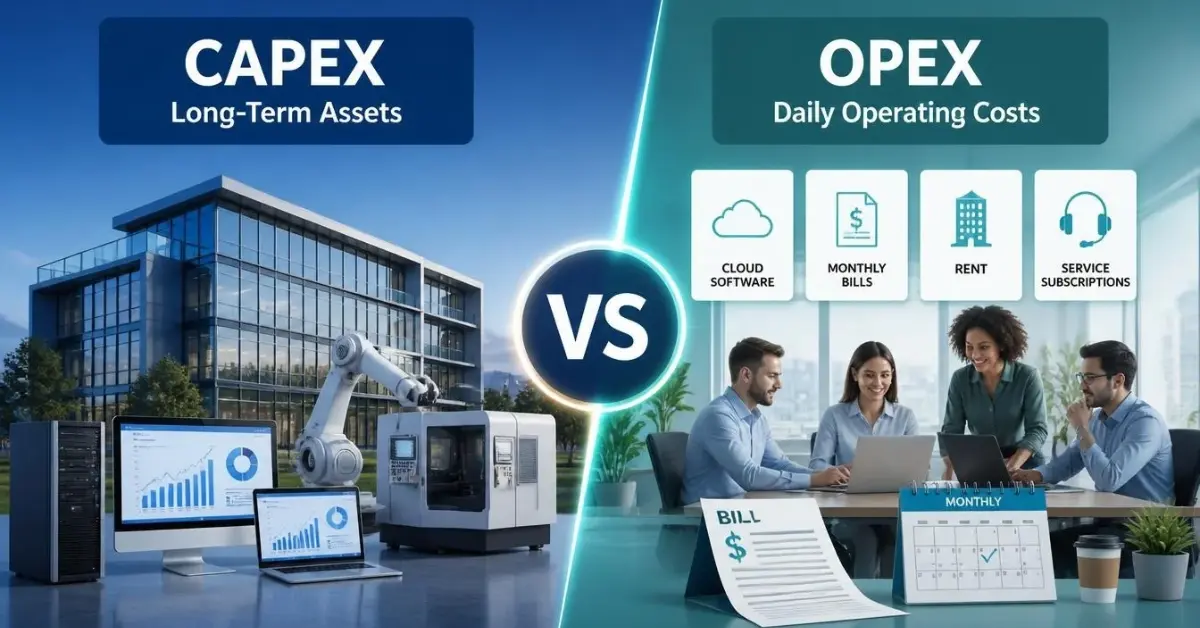
CapEx vs OpEx refers to two types of business spending. CapEx (capital expenditure) is money spent to buy, build, or improve long-term assets, such as buildings, machines, and equipment.
OpEx (operating expenditure) covers the costs of running a business, such as rent, wages, utilities, and routine maintenance. The main difference is how businesses record these costs and how they affect profit, cash flow, and financial reports.
Key Takeaways
- CapEx pays for assets that support a business over time.
- OpEx covers the regular costs of daily business activities.
- CapEx is usually recorded as an asset and its cost is spread over time.
- OpEx is generally recorded as an expense when incurred.
- Some repairs, software costs, and leases need special accounting treatment.
- Both spending types affect business budgets and financial planning.
What Is CapEx?
CapEx stands for capital expenditure. It is money a business spends to buy, build, or improve a long-term asset. These assets help a company make products, serve customers, or run its operations over time.
For example, a factory may buy a new production machine. A store may buy a building. A delivery company may buy new trucks. These purchases may qualify as CapEx because they provide value beyond the current accounting period.
Businesses often make capital investments to:
- Increase production.
- Improve work speed.
- Expand their operations.
- Replace old equipment.
- Support future growth.
The cost, type of asset, useful life, and company accounting policy all matter when deciding how to record a purchase.
Common Examples of CapEx
Some common examples include:
- Buying land or commercial property.
- Purchasing manufacturing equipment.
- Building a new office or warehouse.
- Buying company vehicles.
- Installing major production systems.
- Buying qualifying software assets.
- Making major building improvements.
The main purpose of CapEx is to build or improve the assets a business needs over time.
How CapEx Works in Accounting
Businesses usually record qualifying capital expenditures on their balance sheets as assets. Instead of recording the full cost as an expense at once, they often spread it over the asset’s useful life.
This process is called depreciation for physical assets and amortization for certain intangible assets. For example, suppose a company buys equipment for $50,000. It expects to use the equipment for five years.
Assume the equipment has no remaining value at the end of those five years. If the company uses straight-line depreciation, the calculation is:
$50,000 ÷ 5 = $10,000 per year.
The company records $10,000 in depreciation expense each year under this example. This helps match the cost of the asset with the years in which it helps the business.
Actual accounting depends on the asset, its useful life, applicable accounting rules, and the company’s capitalization policy. A business may also set a dollar limit for small purchases.
Items below that limit may be expensed instead of recorded as long-term assets, when the policy and applicable rules allow it.
What Is OpEx?
OpEx stands for operating expenditure. It is money a business spends on its regular activities. These costs help a company keep working, serve customers, and manage daily tasks.
Unlike most capital purchases, operating costs are usually used within the current business period. However, some costs may need special accounting treatment.
For example, a business pays monthly rent for its office. It also pays workers, electricity bills, insurance, and marketing costs. These are common examples of OpEx.
Common Examples of OpEx
Operating expenses often include:
- Employee salaries and wages.
- Office rent.
- Electricity and water bills.
- Internet and phone services.
- Business insurance.
- Advertising and marketing.
- Routine equipment maintenance.
- Software subscriptions.
- Professional service fees.
- Office supplies.
These costs help a business run its daily operations.
How OpEx Works in Accounting
Businesses generally record operating expenses on their income statements during the period in which they are incurred. These costs reduce profit for that period.
For example, imagine a small business pays $2,000 in monthly rent.
Its yearly rent cost is:
$2,000 × 12 = $24,000.
The business generally records this amount as rent expense over the year.
However, lease accounting can require a business to record a right-of-use asset and a lease liability. This means the accounting for long-term leases is more complex than ordinary monthly service costs.
It is also important to remember that payment timing and expense timing can differ. Under accrual accounting, a business may record an expense before or after it pays the bill.
CapEx vs OpEx: Key Differences
Both CapEx and OpEx involve business spending, but they serve different purposes.
The table below shows their main differences.
| Comparison | CapEx | OpEx |
|---|---|---|
| Full form | Capital expenditure | Operating expenditure |
| Purpose | Buy or improve long-term assets | Run daily business activities |
| Time period | Often provides value for several years | Usually relates to current operations |
| Accounting | Usually recorded as an asset first | Usually recorded as an expense |
| Main financial statement | Balance sheet initially | Income statement |
| Profit impact | Often spread over time | Generally recognized when incurred |
| Cash flow | Usually investing activities when paid for assets | Usually operating activities |
| Examples | Buildings, machines, vehicles | Rent, wages, utilities |
| Spending pattern | Often large or occasional | Often regular or recurring |
| Main benefit | Builds long-term business value | Supports daily business work |
The simplest way to remember the difference is this: CapEx helps a business buy or improve long-term assets, while OpEx pays for the costs of running the business.
However, size and payment frequency do not decide the classification. The purpose of the cost and the accounting rules matter.
How CapEx & OpEx Affect Financial Statements
The difference between CapEx and OpEx matters when reviewing a company’s financial performance.
Both affect financial statements, but they appear in different ways.
1. Balance Sheet
The balance sheet shows what a business owns and owes. When a company buys a qualifying capital asset, it usually records that asset on its balance sheet.
For example, a company buys a building for $500,000.
The building is recorded as an asset. Its carrying value generally falls over time as depreciation is recorded. OpEx usually does not create a long-term asset.
However, leases and some other costs can require asset or liability recognition under accounting rules.
2. Income Statement
The income statement shows a company’s income, expenses, and profit. OpEx generally reduces operating income during the period in which the expense is recognized.
CapEx usually affects the income statement over time through depreciation or amortization. For example, buying a $30,000 machine does not normally mean recording the full $30,000 as an immediate expense.
Instead, the business usually records depreciation over the machine’s useful life. The exact result depends on the accounting rules and the company’s capitalization policy.
3. Cash Flow Statement
The cash flow statement shows how money moves in and out of a business.
Under common U.S. reporting rules:
- Cash paid to buy long-term assets is generally shown under investing activities.
- Cash paid for normal business costs is generally shown under operating activities.
- Some lease payments may be reported under operating or financing activities, depending on the lease type.
For example, paying cash for a production machine is generally an investing cash outflow. Paying employee wages is generally an operating cash outflow.
A purchase made through financing may also create noncash or financing-related reporting. Therefore, the accounting cost and the cash payment do not always happen at the same time.
Practical CapEx vs OpEx Examples
Consider a small manufacturing business that wants to expand its operations. The company needs new equipment, more employees, and a larger workspace.
Here is how some of its costs may be classified:
| Business Purchase | Classification | Reason |
|---|---|---|
| New production machine | Usually CapEx | Long-term equipment |
| Warehouse purchase | CapEx | Long-term property asset |
| Employee salaries | OpEx | Regular operating cost |
| Monthly electricity bill | OpEx | Daily business cost |
| Routine machine servicing | Usually OpEx | Regular maintenance |
| Major building improvement | Potentially CapEx | May improve or restore the asset |
| Monthly internet service | OpEx | Ongoing service cost |
This example shows why businesses need both spending types. CapEx helps a company build the resources it needs for growth. OpEx keeps those resources working.
Some costs need closer review. Routine repairs are generally OpEx. Work that makes an asset better, restores it, or changes its use may need to be capitalized.
CapEx vs OpEx in Cloud Computing
The difference between CapEx and OpEx is also important in technology and cloud computing. In a traditional IT setup, a company may buy physical servers, network equipment, and storage devices.
These purchases may qualify as CapEx because the company owns and uses the equipment over time. With cloud computing, a business can rent computing power and storage from a service provider.
Instead of buying its own servers, it pays for cloud services. These hosting fees are generally treated as OpEx.
Simple Technology Comparison
| Traditional IT | Cloud Computing |
|---|---|
| Buy physical servers | Use rented cloud resources |
| Large upfront purchase | Regular service fees |
| Own and manage hardware | Provider manages the infrastructure |
| Pay for equipment maintenance | Pay for service and support |
| Hardware may need replacement | Resources can often be changed as needed |
Cloud services can reduce the need for large upfront hardware purchases. They may also make it easier to change resources as business needs change.
However, cloud services are not always cheaper.
Businesses should compare:
- Monthly and yearly service fees.
- Data storage and usage charges.
- Setup and migration costs.
- Security needs.
- Support fees.
- Long-term service costs.
There is also an important accounting detail. Under U.S. GAAP, hosting fees in a cloud service contract are generally expensed as incurred.
However, certain costs to set up or implement the service may qualify for capitalization. This means a cloud service can have both OpEx and capitalized implementation costs.
Tax Differences Between CapEx & OpEx In The USA
CapEx and OpEx can receive different tax treatment under U.S. tax rules. The Internal Revenue Service (IRS) sets rules for business deductions and capital assets.
Operating Expenses
Businesses can generally deduct ordinary and necessary expenses related to running their business, subject to tax rules.
Examples may include:
- Business rent.
- Employee wages.
- Office supplies.
- Utility bills.
- Advertising costs.
- Routine repairs.
Capital Expenditures
Businesses generally recover the cost of qualifying capital assets through depreciation. However, some tax rules may allow a business to deduct part or all of an eligible asset’s cost sooner.
Two important tax provisions are:
1. Section 179
Section 179 allows eligible businesses to deduct the cost of certain qualifying property in the year it is placed in service. The deduction has annual limits, spending limits, and other requirements.
2. Bonus Depreciation
Bonus depreciation allows eligible businesses to deduct a qualifying part of certain asset costs sooner. The percentage depends on the tax year, the date the asset was acquired and placed in service, and other rules.
Under current IRS guidance, certain qualifying property acquired and placed in service after January 19, 2025, may qualify for a 100% special depreciation allowance. Other property and situations can have different rules.
These provisions can change how quickly a business recovers its investment for tax purposes. For this reason, CapEx does not always mean a business must wait several years to receive a tax deduction.
Important: Tax accounting and financial accounting are not always the same. A business may use one treatment in its financial statements and a different allowed treatment on its tax return.
The correct treatment depends on the asset, business use, tax year, and eligibility rules. A qualified tax professional can help review major purchases and deductions.
Which Is Better For a Business?
Neither CapEx nor OpEx is always better. The right choice depends on a company’s goals, available cash, and operating needs.
When CapEx Makes More Sense
CapEx may be a better option when a business:
- Needs equipment for long-term use.
- Plans to increase production.
- Wants to own important business assets.
- Expects long-term value from an investment.
- Has enough cash or financing for a major purchase.
For example, a construction company may buy its own equipment if it expects to use it often for many years.
When OpEx Makes More Sense
OpEx may be a better option when a business:
- Wants to avoid a large upfront purchase.
- Needs flexible services.
- Prefers regular payments.
- Has changing technology needs.
- Wants to reduce equipment ownership duties.
For example, a startup may use cloud software instead of buying and managing its own servers.
How to Choose Between CapEx and OpEx
Before making a spending decision, businesses should consider five things.
1. Total Cost
Compare the full cost of buying an asset with the cost of renting or using a service. Include maintenance, repairs, support, fees, and replacement costs.
2. Cash Flow
Check whether the business can afford a large upfront payment or regular fees. A lower upfront cost does not always mean a lower total cost.
3. Business Needs
Decide whether owning an asset or having access to a service is more useful.
4. Maintenance
Consider who will manage repairs, updates, support, and replacement.
5. Long-Term Value
Think about how the decision may affect future work and business growth. A careful comparison helps businesses choose the option that best fits their needs.
Common CapEx vs OpEx Mistakes
Businesses can make mistakes when they classify their costs. Here are some common ones to avoid.
1. Thinking every large purchase is CapEx
Price alone does not decide how a cost is recorded. The type of purchase and accounting rules matter.
2. Thinking every repair is OpEx
Routine repairs may be OpEx, but work that improves or restores an asset may need to be capitalized.
3. Thinking every software cost is OpEx
Cloud hosting fees are generally OpEx, but certain software and setup costs may qualify for capitalization.
4. Confusing cash flow with profit
A large cash payment does not always mean the full amount becomes an expense at once.
5. Treating tax and accounting rules as the same
Tax rules and financial reporting rules may produce different results.
6. Ignoring future costs
Buying equipment can also bring maintenance, insurance, and replacement costs.
A business should review the full cost before making a decision.
FAQs:
1. Is depreciation CapEx or OpEx?
Depreciation is an expense related to a capital asset. The original purchase may be CapEx, while depreciation is recorded over time on the income statement. Depreciation spreads the cost of an asset over its useful life. It is not a new cash payment each year.
2. Is buying a laptop CapEx or OpEx?
Buying a laptop for long-term business use may qualify as CapEx. However, its accounting treatment depends on the purchase price, company capitalization policy, and applicable rules. A low-cost laptop may be expensed at once if the business policy and relevant rules allow it.
3. Is rent CapEx or OpEx?
Regular office rent is generally an operating cost. However, under U.S. GAAP, many leases longer than 12 months require a business to record a right-of-use asset and a lease liability. Operating and finance leases also have different expense and cash flow rules.
4. Can a business convert CapEx into OpEx?
A business may replace an asset purchase with a rental, lease, or service contract. For example, it can rent equipment instead of buying it. This may reduce upfront spending, but the total cost and accounting treatment should be reviewed before making a decision. The business cannot simply change the accounting label of a purchase without changing the facts or meeting the applicable rules.
5. Which is better for cash flow: CapEx or OpEx?
OpEx often involves smaller, regular payments. This may make short-term cash planning easier. CapEx may require a large upfront payment. However, buying an asset can cost less over several years than renting or subscribing to a service. The better option depends on the business’s cash position and long-term needs.
6. Can the same business cost include both CapEx and OpEx?
Yes. For example, a company may buy a machine through CapEx and pay for routine maintenance through OpEx. A cloud computing contract may also include hosting fees and implementation costs with different accounting treatment. Each part of the cost should be reviewed under the rules that apply.
Conclusion:
Understanding CapEx vs OpEx helps businesses manage spending, prepare financial reports, and plan for growth.
CapEx focuses on buying or improving long-term assets, such as property, equipment, and machinery. OpEx covers the regular costs of running a business, such as wages, rent, utilities, and services. Both are important for a healthy business.
The best approach is to balance both spending types, compare their full costs, and follow the right accounting and tax rules.

Harry Jack is a content writer at ReplyGenius.com who specializes in practical, natural sounding replies for texts, social media, relationships, and everyday conversations.