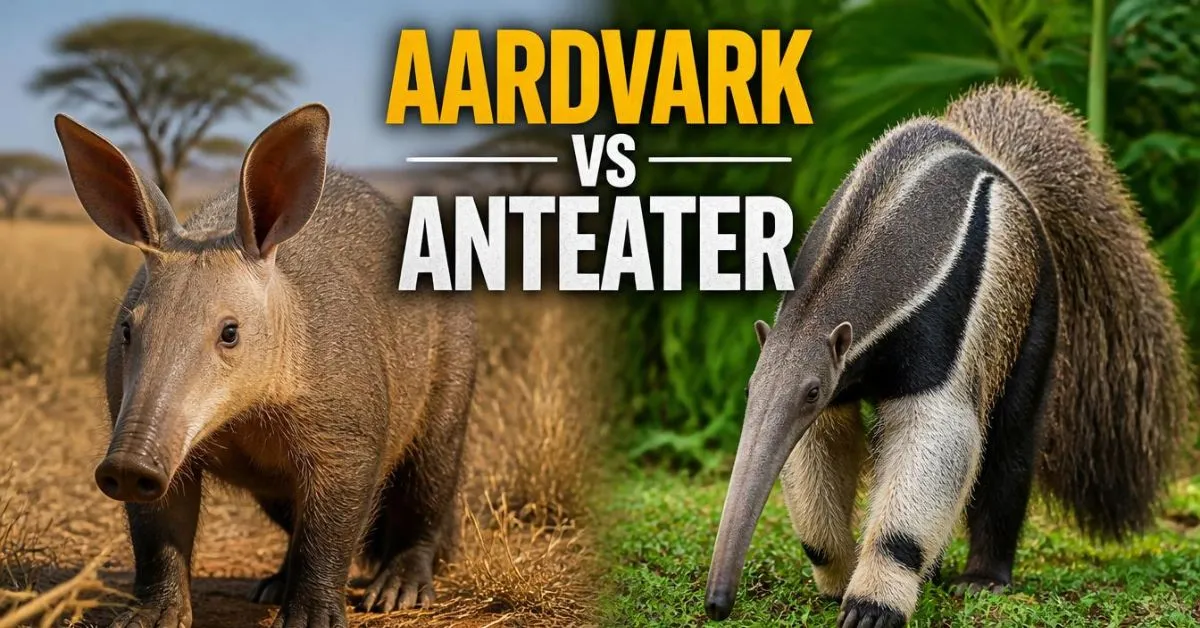
An aardvark and an anteater are different mammals that eat ants and termites. Aardvarks live in Africa and have large ears, sparse hair, and special cheek teeth.
True anteaters live in Central and South America and have long snouts, sticky tongues, and no teeth. They look alike because they evolved similar traits to find the same kinds of food.
Key Takeaways
- Aardvarks live in Africa, while true anteaters live in the Americas.
- Aardvarks have special cheek teeth but no front teeth as adults. True anteaters have no teeth.
- Both use strong claws and long tongues to collect ants and termites.
- Aardvarks dig burrows, while giant anteaters rest above ground.
- Their similar traits are an example of convergent evolution.
Aardvark vs Anteater: Quick Comparison
This table compares an aardvark with a giant anteater, the largest living anteater species.
| Feature | Aardvark | Giant Anteater |
|---|---|---|
| Scientific name | Orycteropus afer | Myrmecophaga tridactyla |
| Animal group | Tubulidentata | Pilosa |
| Native range | Sub-Saharan Africa | Central and South America |
| Body shape | Stocky, with a curved back | Long body and narrow snout |
| Ears | Large and upright | Small and rounded |
| Fur | Sparse, coarse hair | Long, shaggy fur |
| Teeth | Special cheek teeth | No teeth |
| Tongue | Long and sticky | Very long and sticky |
| Tail | Thick at the base, then tapers | Long and bushy |
| Main food | Ants and termites | Ants and termites |
| Shelter | Underground burrows | Often rests on the ground |
| Activity | Mainly at night | Day or night, based on local conditions |
Other anteaters, such as tamanduas and silky anteaters, are much smaller than the giant anteater. Their size and behavior can differ.
1. Appearance & Body Shape
The easiest way to tell an aardvark from a giant anteater is to look at its ears, fur, and tail.
An aardvark has a stocky body, a curved back, a long snout, and large ears. Its skin is gray or gray-brown, with sparse hair. Its thick tail gets thinner toward the tip.
A giant anteater has a long body, a narrow snout, and shaggy fur. Its long, bushy tail stands out. It also has a dark stripe that runs across its shoulders and sides.
Both animals have strong front legs and long claws. These help them break into ant and termite nests.
Quick tip: Large ears and sparse hair point to an aardvark. Shaggy fur and a bushy tail point to a giant anteater.
2. Size & Weight
Aardvarks and giant anteaters are both large mammals that feed on insects, but they differ in size.
An adult aardvark often weighs about 110–180 pounds (50–82 kg). Its strong body and claws help it dig burrows and open insect nests.
A giant anteater often weighs about 60–100 pounds (27–45 kg). It can reach about 6–8 feet (1.8–2.4 m) from nose to tail.
So, which animal is bigger?
An aardvark may weigh more, while a giant anteater may be longer when its tail is included. Weight and total length measure different things, so they do not always give the same answer.
These are common ranges, not fixed limits for every adult. Smaller anteaters, such as tamanduas and silky anteaters, weigh far less than giant anteaters.
3. Habitat & Geographic Range
Aardvarks and true anteaters live in different parts of the world. Their native ranges are among the easiest ways to tell them apart.
Where do aardvarks live?
Aardvarks live across much of sub-Saharan Africa. They use grasslands, savannas, and woodlands where ants and termites are easy to find.
They also need soil they can dig. Their strong claws help them make underground burrows. These burrows provide a place to rest during the day and raise their young.
Where do anteaters live?
True anteaters live in Central and South America. Giant anteaters use grasslands, savannas, wetlands, and forests.
Other anteaters, such as tamanduas and silky anteaters, spend much of their time in trees. Their gripping tails and strong claws help them climb.
Both groups need places with enough insects to eat, but they live on different continents.
The main difference is simple: aardvarks are native to Africa, while true anteaters are native to the Americas.
4. Diet & Feeding Habits
Both animals mainly eat ants and termites. Their long snouts, sticky tongues, and strong claws help them reach insects inside nests.
An aardvark uses its claws to break open a termite mound or ant nest. It then uses its long tongue to collect the insects. It may also eat beetle larvae and the fruit of the aardvark cucumber.
A giant anteater uses its strong front claws to open insect nests. Its long tongue moves in and out quickly. Sticky saliva helps ants and termites cling to it.
Giant anteaters often move from one nest to another instead of feeding at a single nest for a long time. This leaves some insects behind and gives the nest a chance to recover.
Both animals use their strong sense of smell to help find food. Their diets are similar, but aardvarks also eat some plant food.
5. Teeth, Tongues & Claws
Their feeding tools show some of the biggest differences between these mammals.
Teeth
Adult aardvarks have special cheek teeth. They do not have the front incisors and canines found in many other mammals. Their cheek teeth have tiny tubes inside them, which is why their order is called Tubulidentata.
True anteaters have no teeth. They collect small insects with their tongues and swallow them without chewing.
Tongues
Both animals have long, sticky tongues that help them collect insects from narrow spaces.
A giant anteater’s tongue can reach about two feet (60 cm) long. Sticky saliva helps insects cling to it as the animal feeds.
Claws
Both animals have strong front claws for opening nests. Aardvarks also use their claws to dig burrows.
Giant anteaters have very long front claws. They curl their front feet inward and walk on their front knuckles to protect the claws as they move.
These tools help both animals eat similar food, even though they evolved along different paths.
6. Behavior, Shelter & Defense
Aardvarks are mainly nocturnal, which means they are most active at night. They often rest in underground burrows during the day and search for food after dark.
Their burrows offer shelter from heat and danger. After an aardvark leaves a burrow, other animals may use it as a home.
Giant anteaters do not usually dig permanent burrows. They often rest on the ground and may cover their bodies with their large tails.
Their activity can change with local conditions. Giant anteaters may be active during the day in some areas and more active at night where people are common.
Both animals usually live alone. They may come together to mate, and mothers care for their young.
Neither animal should be treated as a pet or handled in the wild. Giant anteaters can defend themselves with their strong front claws if threatened. Aardvarks also have strong claws and bodies that help them dig and escape danger. Both usually avoid contact when they can.
7. Are Aardvarks & Anteaters Related?
Aardvarks and true anteaters are not close relatives.
The aardvark belongs to the order Tubulidentata. It is the only living member of this order.
True anteaters belong to the group Pilosa, which also includes sloths. This means aardvarks and anteaters belong to different branches of mammal evolution.
Their similar features developed through convergent evolution. This means that different animals develop similar traits because they face similar needs.
Both animals eat ants and termites. Long snouts help them reach insects, sticky tongues help them collect food, and strong claws help them open nests.
These shared traits make them look alike, but they do not mean the animals are close relatives.
8. What Are the Different Types of Anteaters?
The word anteater does not refer to just one animal. There are four living anteater species commonly recognized.
- Giant anteater: The largest species. It has a long snout, shaggy fur, and a bushy tail. It mainly lives on the ground.
- Northern tamandua: A smaller species found in parts of Central America and northern South America. It can climb trees.
- Southern tamandua: A small to medium-sized species found in South America. It uses its strong claws and gripping tail to climb.
- Silky anteater: A very small, tree-living species with soft fur. It is well suited to life in trees.
This matters when comparing size and behavior. The giant anteater is the fairest choice for a basic comparison with an aardvark because it is the largest anteater and is often shown in comparison photos.
9. Why Do Aardvarks & Anteaters Matter?
Aardvarks and anteaters play useful roles in their natural habitats.
By eating ants and termites, they affect insect populations. Their feeding can also change the shape of insect nests.
Aardvarks have another important role: their burrows provide shelter for other animals. Once an aardvark leaves a burrow, other species may use it.
Both animals face threats from human activity and changes to their habitats. Giant anteaters face risks such as habitat loss, fires, and road accidents in parts of their range. Threats to aardvarks can vary across Africa.
Protecting their habitats helps these mammals survive and supports other species that share their ecosystems.
How to Tell an Aardvark From an Anteater
If you see one of these animals in a picture, use these five clues:
- Check the ears. Large, upright ears suggest an aardvark.
- Look at the fur. Sparse hair points to an aardvark. Long, shaggy fur points to a giant anteater.
- Check the tail. A large, bushy tail is a key feature of the giant anteater.
- Look at the location. Aardvarks are native to Africa, while true anteaters are native to the Americas.
- Remember the teeth. Aardvarks have special cheek teeth, while true anteaters have none.
One clue may not be enough if the photo is unclear. Use several features together when possible.
FAQs:
Are aardvarks and anteaters the same animal?
No. Aardvarks are African mammals in the order Tubulidentata. True anteaters live in Central and South America and belong to the group Pilosa. Both eat ants and termites, but their bodies, teeth, and evolutionary histories differ.
Which is bigger, an aardvark or a giant anteater?
An aardvark can weigh more than many giant anteaters, but a giant anteater can be longer when its tail is included. The answer depends on whether you compare weight, body length, or total length.
Do aardvarks and anteaters eat the same food?
Both mainly eat ants and termites. Aardvarks may also eat beetle larvae and some fruit. True anteaters mainly eat social insects, though their diet can vary by species.
Do aardvarks have teeth?
Yes. Adult aardvarks have special cheek teeth, but they lack the front incisors and canines found in many mammals. True anteaters have no teeth and use their long tongues to collect small insects.
Why do aardvarks and anteaters look alike?
They look alike because of convergent evolution. Both developed long snouts, sticky tongues, and strong claws to find and eat ants and termites. These shared traits reflect similar feeding needs, not a close family link.
Can aardvarks and anteaters be kept as pets?
They are wild mammals with special diets and care needs. They are not suitable household pets. Laws on keeping wild animals vary by location, so people should not assume that owning one is legal or safe.
Conclusion:
The main difference in the aardvark vs anteater comparison is their biology and native range. Aardvarks live in Africa, have large ears and special cheek teeth, and dig burrows.
True anteaters live in the Americas, have no teeth, and use long tongues to collect insects.
Both animals eat ants and termites, but they belong to different mammal groups. Their similar features are a clear example of convergent evolution.
To tell them apart, look at their ears, fur, tail, teeth, and native range. These clues make the aardvark and giant anteater much easier to identify.

Eric Walker, an author at replyygenius.com, where I create clear and helpful content for readers.
I focus on writing useful, engaging, and easy to understand articles that deliver real value.