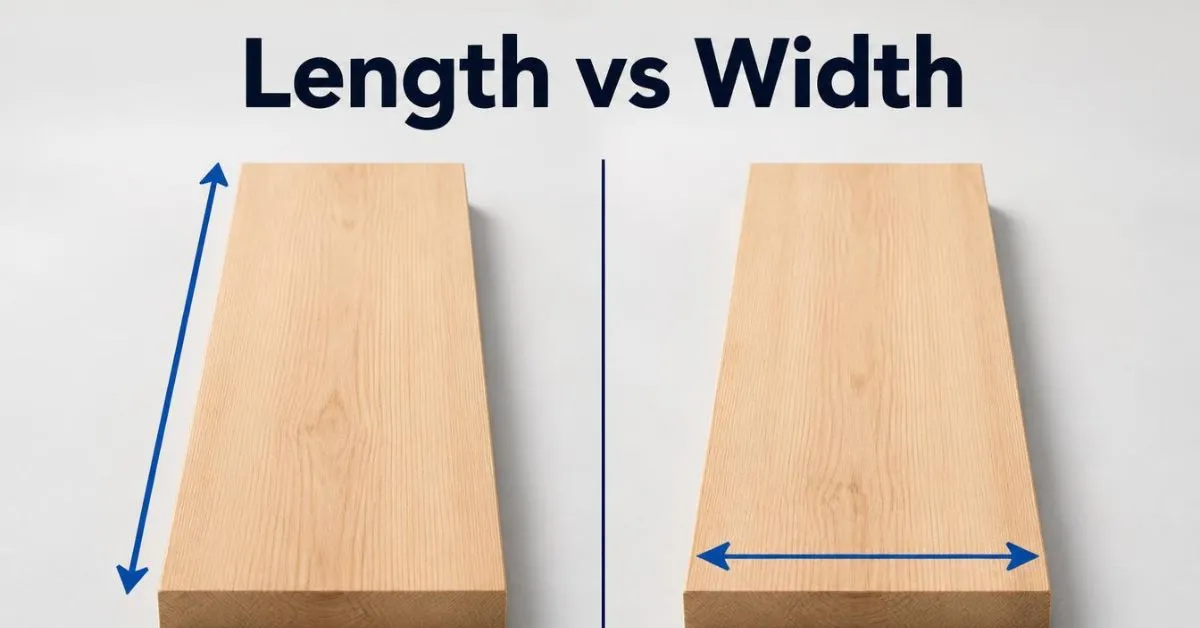
Length vs width comes down to the direction you measure. Length usually describes how long an object is, while width describes how far it extends from side to side. For a rectangle, the longer side is often called the length and the shorter side the width.
However, the right labels depend on the object. Furniture, rooms, doors, and packages may use these terms in different ways.
Key Takeaways
- Length measures how far an object extends from end to end.
- Width measures how far an object extends from one side to the other.
- Length is often greater than width, but not always.
- Height measures how tall something is. Depth often measures from front to back.
- Multiply length by width to find the area of a rectangle.
- Check the labels before buying furniture, measuring a room, or shipping a package.
What Is Length?
Length is the distance from one end of an object to the other. It often describes the direction in which an object extends the most.
For example, a table may be 6 feet long. This means it measures 6 feet along its length.
Common examples of length include:
- The length of a pencil
- The length of a road
- The length of a room
- The length of a table
- The length of a piece of rope
You can measure length in inches, feet, yards, centimeters, meters, or miles. Choose a unit that fits the object. Inches work well for a book, feet work well for a room, and miles work well for a long road.
Simple rule: Length tells you how long something is along a chosen direction.
What Is Width?
Width is the distance from one side of an object to the other. It tells you how wide or broad something is.
For example, a table may be 6 feet long and 3 feet wide. The length runs along the main side, while the width measures across the table.
Here are a few everyday examples:
- A doorway may be 3 feet wide.
- A desk may be 2 feet wide.
- A road may be 30 feet wide.
- A roll of fabric may be 45 inches wide.
Width helps you understand how much space an object takes across its sides. It is useful when you plan a room, buy furniture, or check whether an item will fit through a doorway.
Simple rule: Width tells you how wide something is from one side to the other.
Length vs Width: What’s the Difference?
The main difference is the direction each measurement describes. Length often follows the object’s main direction, while width measures across it.
| Feature | Length | Width |
|---|---|---|
| Meaning | Distance from end to end | Distance from one side to the other |
| Common use | How long something is | How wide something is |
| Rectangle example | 8 feet | 5 feet |
| Room example | Distance along the room | Distance across the room |
| Common units | Inches, feet, meters | Inches, feet, meters |
A simple example
Imagine a rectangular rug that measures 8 feet by 5 feet.
- Length: 8 feet
- Width: 5 feet
The rug is longer than it is wide. These measurements also help you work out how much floor space the rug covers.
In many simple rectangles, people use length for the longer side and width for the shorter side. But this is a common convention, not a rule for every object. The clearest labels depend on the shape and the purpose of the measurement.
Is Length Always Longer Than Width?
No. Length is often greater than width, but the two measurements can be equal, and width can be greater than another dimension.
Consider these examples:
- A square: All four sides are equal. A square with 4-foot sides can be described as 4 feet long and 4 feet wide.
- A door: People usually call the vertical measurement height and the horizontal measurement width.
- A sofa: Width often measures across the front. It may be greater than the sofa’s depth.
- A road: Length describes how far the road runs, while width measures across it.
For a basic rectangle, using length for the longer side and width for the shorter side is often clear. For objects with a clear top, bottom, front, or back, terms such as height and depth may be more useful.
The goal is to label each measurement so another person can understand exactly what it means.
Length vs Width vs Height vs Depth vs Breadth
Length and width describe two dimensions. A three-dimensional object also has a third dimension, often called height or depth.
| Term | Meaning | Example |
|---|---|---|
| Length | Distance from end to end | A box is 12 inches long |
| Width | Distance across an object | A box is 8 inches wide |
| Height | Distance from bottom to top | A box is 6 inches high |
| Depth | Distance from front to back or inward | A cabinet is 18 inches deep |
| Breadth | Another word for width | A table is 3 feet broad |
How do width & depth differ?
Width usually measures across the front or from one side to the other. Depth often measures from the front toward the back.
For example, a cabinet may be:
- 36 inches wide
- 18 inches deep
- 72 inches high
This means the cabinet is 36 inches across the front, extends 18 inches into the room, and stands 72 inches tall.
Width and depth can overlap in meaning. Their labels depend on the object and the way its dimensions are described. If a measurement could be unclear, label it directly.
What do length, width & height mean on a box?
A box may measure 12 × 8 × 6 inches. If the measurements are listed as length × width × height, the box is 12 inches long, 8 inches wide, and 6 inches high.
However, do not assume every seller uses the same order. Read the labels before using the numbers to check fit or calculate volume.
How to Measure Length & Width Correctly
You can measure most objects with a ruler or tape measure. First, decide which sides you need to measure. Then measure each side and record its label and unit.
Steps for measuring a flat object
- Place the object on a flat surface, if possible.
- Identify the direction you will call the length.
- Measure from one end to the other.
- Measure across the object, at a right angle to the length.
- Write down both measurements with their units.
For example, a notebook may measure 11 inches from top to bottom and 8.5 inches across. You could record it as 11 × 8.5 inches, with length first, if that is the convention you are using.
Steps for measuring a box
For a shipping box, the carrier’s rules may define the measurements. UPS, for example, uses the longest side as the length.
- Measure the longest side as the length.
- Measure the next side as the width.
- Measure the remaining side as the height.
- Record all three measurements in the required unit.
- Follow the carrier’s rounding and size rules.
How to avoid measuring mistakes
- Keep the tape measure straight.
- Start at the correct edge.
- Use the same unit for all measurements.
- Measure the widest or tallest part when the instructions require it.
- Include handles, feet, or other parts that may affect fit.
- Write each label beside its number.
- Check the space an item must pass through, not just the space where it will sit.
Length & Width Examples in Real Life
1. Rooms and floors
Suppose a rectangular room is 15 feet long and 12 feet wide.
- Length: 15 feet
- Width: 12 feet
To find the floor area, multiply the two measurements:
Area = Length × Width
Area = 15 × 12 = 180 square feet
The room has an area of 180 square feet. This calculation can help when you plan flooring, arrange furniture, or compare room sizes.
2. Furniture and doors
A sofa may be listed as 84 inches wide, 36 inches deep, and 34 inches high.
Here, width measures across the front, depth measures from front to back, and height measures from the bottom to the top.
For a door, width measures across the opening, while height measures from the bottom to the top.
When buying furniture, measure the space where the item will go. Also measure doorways, hallways, and turns along the path. A sofa may fit in a room but still be too large to carry through the entrance.
3. Boxes and packages
A box may measure 16 × 10 × 8 inches.
If the seller uses length × width × height, the box is 16 inches long, 10 inches wide, and 8 inches high.
These measurements help you check storage space and package size. For shipping, follow the carrier’s measurement rules. The carrier may use the longest side as the length and may require you to round measurements up.
4. TVs and computer screens
A TV’s screen size usually refers to its diagonal. This is the distance from one corner of the screen to the opposite corner.
A 55-inch TV does not have a width of 55 inches. Its width is shorter than its diagonal measurement.
If you need a TV to fit inside a cabinet, check its listed width and height. Also check the stand, the bezel, and the space needed for cables.
5. Clothing and fabric
Clothing measurements depend on the item and the brand. For example, shirt length may run from the shoulder to the bottom hem, while chest width may measure across the chest.
Fabric width usually means the distance across the fabric roll. Fabric length means how much fabric runs along the roll.
Always check the measurement guide. Brands may use different points to measure clothing, so two items with the same label may not fit the same way.
How to Calculate Area Using Length and Width
You can find the area of a rectangle by multiplying its length by its width.
Formula:
Area = Length × Width
For example, a garden is 10 feet long and 6 feet wide.
Area = 10 × 6 = 60 square feet
The garden covers 60 square feet.
Notice that the answer uses square feet, not feet. Length and width measure distance. Area measures the amount of surface inside a shape.
What if the units are different?
Convert the measurements to the same unit before multiplying.
For example, a rectangle is 4 feet long and 24 inches wide. Since 24 inches equals 2 feet, you can calculate the area like this:
Area = 4 feet × 2 feet = 8 square feet
Do not multiply 4 feet by 24 inches and label the answer as square feet. Convert the units first.
What about volume?
Area measures a flat surface. Volume measures the space inside a three-dimensional object.
For a rectangular box, use this formula:
Volume = Length × Width × Height
If a box is 12 inches long, 8 inches wide, and 6 inches high:
Volume = 12 × 8 × 6 = 576 cubic inches
The box has a volume of 576 cubic inches.
Length vs Width vs Diagonal
A diagonal measures the distance between two opposite corners of a shape. It is different from length and width.
For example, a rectangular screen is 20 inches wide and 15 inches high. Its diagonal is 25 inches.
This matters when buying a TV or monitor because screen sizes are usually measured diagonally, not across the screen.
For a rectangle, the diagonal depends on both the width and height. You cannot find it by simply adding the two measurements.
Common Measurement Mistakes to Avoid
Assuming length is always horizontal. Length can run in different directions. Choose a clear reference and label it.
Assuming length must always be greater than width. This is common for rectangles, but squares have equal sides, and other objects use different naming rules.
Mixing up width and height. Width usually measures across an object, while height measures from bottom to top.
Confusing width with depth. Width often measures across the front, while depth measures from front to back.
Mixing inches and feet. Convert measurements to the same unit before doing calculations.
Guessing the order of product dimensions. Check the labels or ask the seller what each number means.
Forgetting the path into a room. Check doorways, hallways, and turns before moving large furniture.
Using the wrong formula. Length × width gives the area of a rectangle. Length × width × height gives the volume of a rectangular box.
FAQs:
What comes first, length or width?
Length usually comes before width in a length × width description. For example, a rug may be listed as 8 × 5 feet. However, sellers may use different formats, so check the labels before relying on the order.
Is length horizontal or vertical?
Length can run in either direction. It describes the distance along an object. Height usually describes how tall something is, while width often measures across it.
Can length and width be the same?
Yes. A square has equal sides. A square table with 4-foot sides can be described as 4 feet long and 4 feet wide.
Is width the same as breadth?
Width and breadth often mean the same thing: the distance from one side to the other. Width is more common in everyday American English, while breadth is also used in formal or technical contexts.
Which is bigger, length or width?
Length is often greater than width for a rectangle, but this is not always true. A square has equal sides, and the naming of dimensions depends on the object and the context.
How do I write length and width correctly?
Use clear labels and a consistent unit. For example, write “Length: 8 feet; Width: 5 feet” instead of listing two numbers without explanation. This makes the measurements easier to understand.
Conclusion:
The main difference between length and width is the direction each measurement describes. Length usually measures how far an object extends from end to end, while width measures how far it extends from one side to the other.
For a simple rectangle, the longer side is often called the length and the shorter side the width. For furniture, doors, boxes, and other objects, the correct labels depend on the context.
To measure accurately, identify each side, use the right units, and label the results clearly. This simple habit can help you avoid mistakes when shopping, planning a room, calculating area, or shipping a package.

Emily Carter is a dedicated author at ReplyGenius.com, creating helpful, natural, and engaging content focused on replies, messages, and everyday conversations.