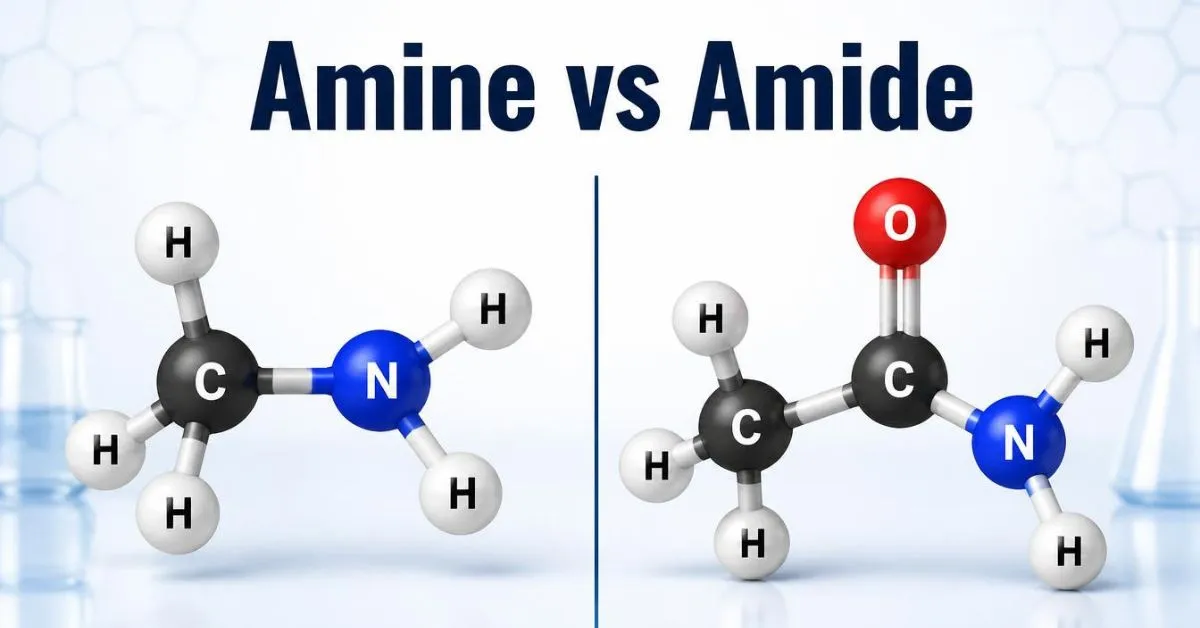
The main difference between an amine and an amide is their structure. An amine has nitrogen bonded to carbon and/or hydrogen.
An amide has nitrogen directly bonded to a carbonyl carbon (C=O). This structural difference affects basicity, reactions, and naming. Typical amines are more basic than typical amides.
Key Takeaways
- Amines are related to ammonia (NH₃) and contain an amine group.
- Amides have nitrogen directly bonded to a carbonyl carbon.
- Amines are usually more basic than amides.
- Primary, secondary, and tertiary amines are classified by the number of carbon groups attached to nitrogen.
- Amide bonds link amino acid residues in proteins.
- To identify an amide, look for a carbonyl carbon directly bonded to nitrogen.
What Is the Difference Between an Amine and an Amide?
Amines and amides are organic compounds that contain nitrogen. Their structures may look similar, but one important bond separates them.
An amine is related to ammonia (NH₃). One or more hydrogen atoms in ammonia are replaced by organic groups. For example, methylamine (CH₃NH₂) is an amine.
An amide contains a carbonyl group (C=O) with its carbon atom directly bonded to nitrogen. Acetamide (CH₃CONH₂) is one example.
The difference affects how these compounds behave. Amines are usually more basic because their nitrogen lone pair can accept a proton (H⁺). In an amide, the nitrogen lone pair interacts with the carbonyl group, making it less available to accept a proton.
The easiest way to tell them apart is to check whether the nitrogen is directly bonded to a carbonyl carbon.
Amine vs Amide: Structure & General Formula
Amine Structure
An amine has a nitrogen atom bonded to carbon-containing groups, hydrogen atoms, or both. A typical neutral amine has three bonds around nitrogen and one lone pair of electrons.
Common formulas for simple amines are:
- Primary amine: R–NH₂
- Secondary amine: R₂NH
- Tertiary amine: R₃N
Here, R represents an organic group, such as a carbon chain. The groups attached to nitrogen may be the same or different.
Examples include:
- Methylamine: CH₃NH₂
- Dimethylamine: (CH₃)₂NH
- Trimethylamine: (CH₃)₃N
These examples show how nitrogen can have one, two, or three organic groups attached to it.
Not every compound that contains nitrogen is an amine. Nitriles, nitro compounds, and imines have different functional groups. Always check the full structure before naming a compound.
Amide Structure
A common carboxamide has a carbonyl carbon directly bonded to nitrogen.
Its basic structure is:
R–C(=O)–N
Common carboxamide formulas include:
- Primary carboxamide pattern: R–CONH₂
- Secondary carboxamide pattern: R–CONHR′
- Tertiary carboxamide pattern: R–CONR′R″
R, R′, and R″ represent organic groups. They may be the same or different.
Examples include:
- Acetamide: CH₃CONH₂
- N-Methylacetamide: CH₃CONHCH₃
- N,N-Dimethylacetamide: CH₃CON(CH₃)₂
Look for the C=O group in each example. The carbonyl carbon is directly bonded to nitrogen.
This carbon–nitrogen bond is the main structural clue that identifies a carboxamide. Chemistry LibreTexts explains amide structure and resonance in more detail.
Amine vs Amide Comparison Table
| Feature | Amine | Amide |
|---|---|---|
| Main structure | Nitrogen bonded to carbon and/or hydrogen | Carbonyl carbon directly bonded to nitrogen |
| Common formula | RNH₂, R₂NH, or R₃N | RCONH₂, RCONHR, or RCONR₂ |
| Carbonyl group | Not part of the amine group itself | Present in a carboxamide |
| Basicity | Usually more basic | Much less basic at nitrogen |
| Nitrogen lone pair | More available to accept a proton | Delocalized toward the carbonyl group |
| Common naming ending | -amine | -amide |
| Example | Methylamine | Acetamide |
| Biological role | Found in many biological compounds | Peptide bonds link amino acid residues |
| Common uses | Medicines and chemical manufacturing | Medicines, proteins, and synthetic materials |
These comparisons describe common amines and carboxamides. Other groups in a molecule can also affect its properties.
Primary, Secondary & Tertiary Amines and Amides
Both amines and amides may be described using the terms primary, secondary, and tertiary. However, the classification rules need care.
How Amines Are Classified
For simple amines, count the organic groups attached directly to nitrogen.
- Primary amine: One organic group is attached to nitrogen. Example: CH₃NH₂.
- Secondary amine: Two organic groups are attached to nitrogen. Example: (CH₃)₂NH.
- Tertiary amine: Three organic groups are attached to nitrogen. Example: (CH₃)₃N.
A primary amine has two N–H bonds. A secondary amine has one, while a tertiary amine has none.
A nitrogen atom bonded to four groups and carrying a positive charge forms a quaternary ammonium ion. It is not a tertiary amine.
How Amides Are Classified
In many introductory chemistry courses, carboxamides are grouped by the number of organic groups attached to the amide nitrogen:
- Primary amide: CH₃CONH₂
- Secondary amide: CH₃CONHCH₃
- Tertiary amide: CH₃CON(CH₃)₂
In this classroom system, the labels reflect how many hydrogen atoms on the amide nitrogen have been replaced by organic groups.
There is an important terminology detail. IUPAC’s formal classification can instead refer to the number of acyl groups attached to nitrogen. Therefore, formal terminology does not always match the classroom system above. Follow the method specified by your course or reference. See the IUPAC Gold Book entry on amides.
The key point is to identify the functional group first, then apply the correct classification system.
Why Are Amines More Basic Than Amides?
Basicity describes how readily a substance accepts a proton (H⁺).
Typical amines are much more basic than typical amides because the nitrogen electrons behave differently in each group.
Basicity of Amines
A typical amine has a lone pair of electrons on nitrogen. This pair can bond with a proton.
For example:
CH₃NH₂ + H⁺ → CH₃NH₃⁺
Methylamine accepts a proton and forms a positively charged ion called methylammonium.
This ability to accept a proton explains why amines act as bases. Amines can also react with acids to form ammonium salts.
Basicity of Amides
In an amide, the nitrogen lone pair interacts with the nearby carbonyl group. This effect is called resonance.
The lone pair becomes delocalized across the nitrogen–carbonyl system. In simple terms, the electrons are shared across more than one bond instead of remaining fully available on nitrogen.
As a result, the nitrogen is less ready to accept a proton. This makes typical amides much less basic than typical amines.
Not all amines have the same basic strength. For example, aniline is less basic than many simple alkylamines because its nitrogen lone pair interacts with the benzene ring.
Remember: The functional group gives you a useful starting point, but the full molecular structure also affects basicity.
Physical Properties of Amines & Amides
Amines and amides can differ in boiling point, hydrogen bonding, and water solubility.
Boiling Point
Small amides often have higher boiling points than similar-sized amines. Their strong attractions between molecules help explain this trend.
However, boiling points also depend on molecular size, shape, and other structural features. The trend does not apply to every possible pair of compounds.
Hydrogen Bonding
Hydrogen bonding helps explain many physical properties.
- Primary and secondary amines have N–H bonds, so they can donate hydrogen bonds. Their nitrogen can also accept hydrogen bonds.
- Primary and secondary amides can donate hydrogen bonds through N–H bonds. Their carbonyl oxygen can accept hydrogen bonds.
- Tertiary amines have no N–H bond, so they cannot donate hydrogen bonds through nitrogen. Their nitrogen may still accept hydrogen bonds.
- Tertiary amides have no N–H bond, so they cannot donate hydrogen bonds through nitrogen. Their carbonyl oxygen can still accept hydrogen bonds.
Water Solubility
Many small amines and amides dissolve in water. As the carbon chain grows, water solubility often decreases because the nonpolar part of the molecule becomes larger.
These are general trends. The full structure of each compound determines its actual properties.
Chemical Reactions of Amines & Amides
Common Amine Reactions
Amines can act as bases because nitrogen can accept a proton. When an amine reacts with an acid, it may form an ammonium salt.
For example:
CH₃NH₂ + HCl → CH₃NH₃⁺Cl⁻
Methylamine reacts with hydrochloric acid to form methylammonium chloride.
Amines can also act as nucleophiles. A nucleophile uses an available electron pair to form a new bond with a suitable reaction partner.
The exact reactions depend on the amine’s structure and the reaction conditions.
Common Amide Reactions
Amides can undergo hydrolysis, a reaction in which water helps break a chemical bond.
Under suitable acidic conditions, a carboxamide can produce a carboxylic acid and an ammonium-containing product. Under basic conditions, it can produce a carboxylate salt and an ammonia- or amine-related product.
The exact products depend on the starting compound and the reaction conditions.
Amide bonds are often stable under mild conditions, but heat, strong acids, strong bases, or enzymes can help break them. In the body, enzymes called proteases help break peptide bonds during protein digestion.
Examples and Uses of Amines and Amides
Examples of Amines
Methylamine: A simple amine used in chemical manufacturing.
Dimethylamine: A secondary amine used to make other chemicals.
Dopamine: A chemical messenger in the body that contains an amine group.
Aniline: An aromatic amine used to produce chemicals and materials.
Amines occur in many medicines, dyes, and biological compounds. Their properties depend on the groups attached to nitrogen.
Examples of Amides
Acetamide: A simple carboxamide used in chemical studies and industrial chemistry.
Peptide bonds: These amide bonds connect amino acid residues in proteins.
Nylon: This synthetic material contains amide links in its polymer chains.
Paracetamol (acetaminophen): This medicine contains an amide group as well as a phenol group.
These examples show that the same functional group can appear in compounds with very different roles. Structure helps determine how each compound behaves.
How to Identify an Amine or Amide
Use these steps when you study a structural formula.
- Find the nitrogen atom. Check which atoms are directly bonded to it.
- Look for a carbonyl group. Find a carbon atom double-bonded to oxygen (C=O).
- Check the carbon–nitrogen bond. If the carbonyl carbon is directly bonded to nitrogen, the structure contains an amide group.
- Check for an amine group. If the nitrogen fits an amine structure and is not part of an amide group, it may be an amine.
- Check the whole molecule. A compound can contain more than one functional group.
Try these examples:
| Formula | Identification | Why |
|---|---|---|
| CH₃NH₂ | Amine | Nitrogen is not bonded to a carbonyl carbon |
| CH₃CONH₂ | Amide | Nitrogen is directly bonded to a carbonyl carbon |
| CH₃COOH | Carboxylic acid | It has no nitrogen |
| CH₃CONHCH₂NH₂ | Both an amide and an amine | One nitrogen is part of an amide; the other belongs to an amine group |
The last example is important. A molecule can contain both functional groups. Do not assume that the whole molecule must fit only one category.
Naming Amines & Amides
A compound’s name can help identify its functional group, but always check the structure when possible.
Naming Amines
Simple amines often use the suffix -amine.
Examples:
- CH₃NH₂: Methanamine; common name, methylamine.
- CH₃CH₂NH₂: Ethanamine; common name, ethylamine.
In more complex compounds, the amine group may be named as an amino substituent. The prefix N- identifies a group attached directly to nitrogen.
Naming Amides
Simple carboxamides use the suffix -amide.
Examples:
- CH₃CONH₂: Ethanamide; common name, acetamide.
- CH₃CONHCH₃: N-methylethanamide.
- CH₃CON(CH₃)₂: N,N-dimethylethanamide.
The prefix N- shows that a group is attached directly to the nitrogen atom. If two methyl groups are attached to nitrogen, the name uses N,N-.
For school exams, learn the common and systematic names required by your course.
Common Mistakes to Avoid
Mistake 1: Assuming Every Nitrogen Compound Is an Amine
Nitro compounds, nitriles, imines, and amides all contain nitrogen, but they have different functional groups.
Mistake 2: Looking for Nitrogen Alone
Nitrogen by itself does not identify an amine or an amide. For a carboxamide, the key feature is a carbonyl carbon directly bonded to nitrogen.
Mistake 3: Saying All Amines Are Strong Bases
Amines vary in basicity. Their structure and surrounding chemical groups affect how readily they accept a proton.
Mistake 4: Treating Amides as Completely Unreactive
Amides can react under suitable conditions. Hydrolysis is one important example.
Mistake 5: Mixing Up Primary, Secondary, and Tertiary Labels
For simple amines, count the organic groups attached directly to nitrogen. For amides, check which classification system your course or reference uses.
FAQs:
What is the main difference between an amine and an amide?
An amine has a nitrogen atom that fits the amine functional group. In a carboxamide, nitrogen is directly bonded to a carbonyl carbon. This difference affects basicity, reactions, and naming.
Are amines more basic than amides?
Yes, typical amines are much more basic than typical amides. An amine’s nitrogen lone pair is more available to accept a proton. In an amide, the lone pair interacts with the carbonyl group through resonance.
Can a molecule contain both an amine and an amide?
Yes. A molecule can contain an amide group in one part and a separate amine group elsewhere. For example, CH₃CONHCH₂NH₂ contains both groups.
Are amides found in proteins?
Yes. Peptide bonds link amino acid residues in proteins. A peptide bond is a type of amide bond that helps hold the protein chain together.
How can I tell an amine from an amide in an exam?
Look for nitrogen and check the atoms bonded to it. If nitrogen is directly bonded to a carbonyl carbon, the group is an amide. If it fits the amine structure and is not part of an amide group, it is an amine.
Which is more stable, an amine or an amide?
There is no single answer for every compound or reaction. However, resonance gives the amide group extra stability by delocalizing the nitrogen lone pair toward the carbonyl group. This also makes the amide nitrogen much less basic than a typical amine nitrogen.
Conclusion:
The main difference between an amine and an amide is the structure around nitrogen. Amines are related to ammonia, while carboxamides have nitrogen directly bonded to a carbonyl carbon.
Amines are usually more basic because their nitrogen lone pair is more available to accept a proton. In amides, resonance spreads this electron pair toward the carbonyl group. This affects basicity, reactions, and physical properties.
To identify the two groups, check the structure first. Look for a carbonyl carbon directly bonded to nitrogen, then examine the rest of the molecule. This simple method helps you compare amines and amides and avoid common organic chemistry mistakes.

Aiden Robert, an author at ReplyyGenius.com, where I share smart conversation tips, flirty replies, and practical communication ideas to help people reply with confidence.