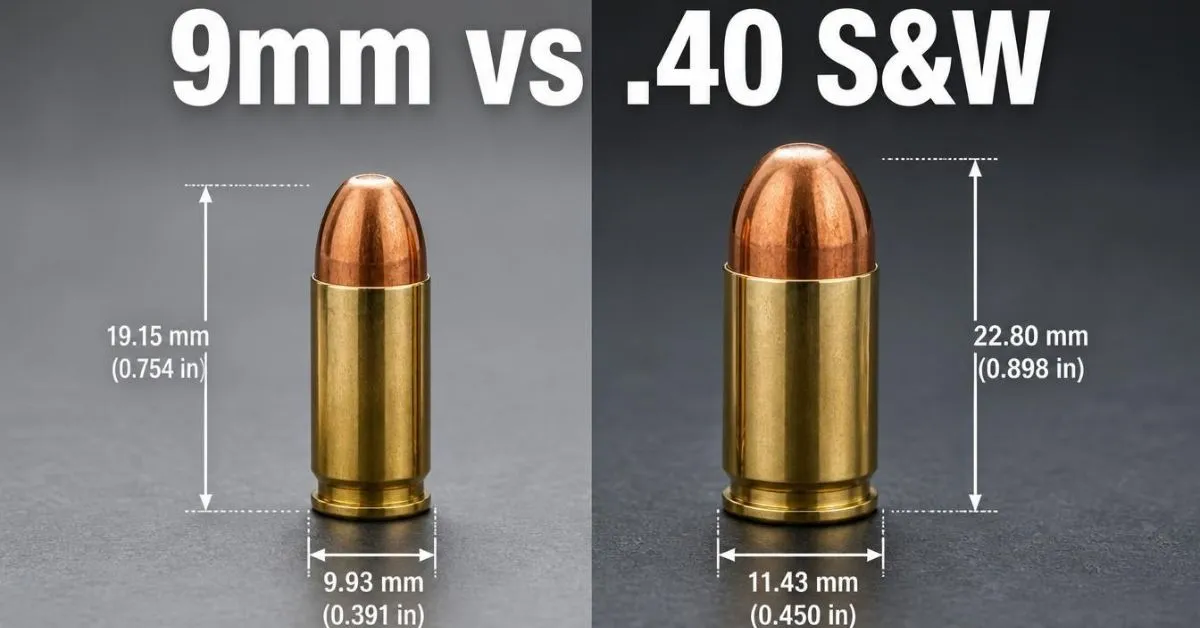
The main difference between 9mm and .40 S&W is their cartridge design and bullet diameter. 9mm Luger uses a smaller-diameter bullet, while .40 S&W uses a larger .40-caliber bullet.
In comparable handguns, 9mm generally has less perceived recoil and can offer higher magazine capacity, while .40 S&W typically produces a stronger recoil impulse. Exact characteristics depend on the firearm and ammunition.
Key Takeaways
- 9mm Luger and .40 S&W are different handgun cartridges.
- 9mm uses a smaller bullet diameter than .40 S&W.
- .40 S&W generally produces a stronger recoil impulse in comparable firearms.
- 9mm commonly allows greater magazine capacity in similarly sized handgun designs.
- Ammunition design can affect velocity, energy, and other performance characteristics.
- Neither cartridge can be accurately compared using bullet diameter or muzzle energy alone.
- The specific firearm and ammunition can make a significant difference.
What Is the Difference Between 9mm & .40 S&W?
The 9mm vs .40 S&W comparison involves two different handgun cartridges with different dimensions and characteristics.
9mm Luger, also called 9x19mm or 9mm Parabellum, uses a nominal bullet diameter of about .355 inches. .40 S&W uses a larger bullet with a nominal diameter of about .400 inches.
That difference in diameter is easy to identify, but it does not tell the whole story.
The two cartridges can also differ in recoil characteristics, magazine capacity, ammunition specifications, and historical use. The exact result depends on the particular firearm and ammunition being compared.
9mm vs .40 S&W: Quick Comparison
| Feature | 9mm Luger | .40 S&W |
|---|---|---|
| Cartridge | 9x19mm | .40 S&W |
| Nominal bullet diameter | About .355 in. | About .400 in. |
| Recoil | Generally lower in comparable firearms | Generally higher in comparable firearms |
| Magazine capacity | Often higher in similar designs | Often lower in similar designs |
| Bullet weights | Vary by ammunition | Vary by ammunition |
| Ammunition selection | Very broad | Broad |
| Historical use | Military, law enforcement, civilian | Strong law-enforcement and civilian use |
| Performance | Depends on firearm and ammunition | Depends on firearm and ammunition |
These are general characteristics rather than fixed rules. Different firearm designs and ammunition specifications can produce different results.
9mm vs .40 S&W: Size & Bullet Diameter
One of the simplest ways to understand the difference is to compare bullet diameter.
9mm Luger
A standard 9mm Luger bullet has a nominal diameter of approximately .355 inches.
The 9mm cartridge is relatively compact, which allows many handgun designs to accommodate comparatively high magazine capacities.
.40 S&W
A .40 S&W bullet has a nominal diameter of approximately .400 inches.
The larger diameter is one of the defining physical differences between the two cartridges. However, bullet diameter alone does not determine overall cartridge performance.
Bullet weight, construction, velocity, barrel length, and firearm design can all affect the characteristics of a particular load.
9mm vs .40 S&W: Recoil
Recoil is one of the most noticeable differences between 9mm and .40 S&W.
In comparable firearms, .40 S&W generally produces a stronger and sharper recoil impulse than 9mm.
However, the cartridge is only one part of the equation.
Recoil can also be affected by:
- Firearm weight
- Grip design
- Ammunition
- Bullet weight
- Operating system
- Overall firearm design
This means two firearms chambered for the same cartridge can feel noticeably different.
It is therefore more accurate to describe .40 S&W as generally producing more perceived recoil in comparable firearms rather than treating recoil as an identical experience across every model.
9mm vs .40 S&W: Ballistics
Ballistic comparisons can become complicated because there is no single specification that represents every 9mm cartridge or every .40 S&W cartridge.
Different ammunition can use different bullet weights, constructions, and velocities. As a result, two loads in the same caliber can have different specifications.
Velocity
9mm ammunition is available with a wide range of bullet weights and velocities. .40 S&W ammunition also comes in different configurations, often including heavier projectiles.
Velocity by itself does not provide a complete picture of cartridge performance.
Muzzle Energy
Muzzle energy depends on both bullet weight and velocity. Changing either variable changes the calculated energy.
Some .40 S&W loads can produce greater muzzle energy than some common 9mm loads. However, comparing one individual load from each cartridge does not establish a universal difference between the two cartridges.
Terminal Performance
Terminal performance is particularly dependent on ammunition design and testing conditions.
Different bullet constructions can produce different results, even within the same caliber. For that reason, broad statements about one cartridge always performing better than the other can be misleading.
9mm vs .40 S&W: Magazine Capacity
Magazine capacity is another commonly discussed difference.
Because the 9mm cartridge is narrower, similarly sized handgun designs can often accommodate more 9mm cartridges than .40 S&W cartridges.
However, there is no universal capacity number for either cartridge.
Capacity depends on the specific firearm and magazine design. Even when a particular handgun model is available in both calibers, the corresponding versions can have different capacities.
For an accurate comparison, check the manufacturer’s specifications for the exact firearm rather than assuming every 9mm or .40 S&W handgun has the same capacity.
Why Did .40 S&W Become So Popular?
The history of .40 S&W explains much of its importance in the American handgun market.
The cartridge was introduced in 1990 and became widely used by law-enforcement agencies and civilian shooters.
It offered a larger-diameter projectile than 9mm while fitting into semi-automatic handgun designs that were already widely used.
For many years, .40 S&W was therefore a prominent law-enforcement cartridge.
Its history is an important part of the 9mm vs .40 S&W discussion because the popularity of the two cartridges has changed over time.
Why Is 9mm So Common Today?
9mm has become extremely widespread in modern handguns.
Several factors have contributed to its popularity, including:
- Generally manageable recoil
- Broad ammunition availability
- A large selection of firearms
- High capacity in many handgun designs
- Extensive military and law-enforcement use
- A large civilian market
The popularity of 9mm does not mean .40 S&W disappeared. .40 S&W remains an established cartridge with existing firearms and commercially available ammunition.
9mm vs .40 S&W Ammo Availability
Both cartridges have been commercially established for decades, but 9mm has become especially widespread.
Ammunition availability can vary based on:
- Manufacturer
- Bullet type
- Quantity
- Retailer
- Market conditions
- Location
Because prices and inventory change, it is better to compare current products rather than claim that one cartridge is always cheaper or easier to find.
The same principle applies to ammunition selection: availability can vary significantly between markets and over time.
Is .40 S&W More Powerful Than 9mm?
This question needs some context.
Many .40 S&W loads use heavier bullets and can produce greater muzzle energy than many common 9mm loads. But the word powerful can oversimplify a technical comparison.
A cartridge comparison can involve several different specifications, including:
- Bullet weight
- Velocity
- Muzzle energy
- Bullet construction
- Recoil
- Barrel length
- Firearm design
- Testing conditions
Therefore, it is more accurate to say that .40 S&W generally uses a larger-diameter projectile and can produce higher muzzle energy with some loads, rather than claiming that one cartridge is universally superior.
What Should You Compare When Researching 9mm vs .40 S&W?
If you’re researching the two cartridges, looking at the caliber number alone isn’t enough.
Recoil
Recoil characteristics can vary depending on the firearm, ammunition, and overall design.
Capacity
Magazine capacity is determined by the specific firearm and magazine rather than the cartridge name alone.
Ammunition
Different ammunition specifications can produce different characteristics, so comparisons should identify the specific loads being discussed.
Firearm Design
A firearm’s size, weight, operating system, and construction can affect how a cartridge behaves.
Availability
Ammunition availability and pricing can change by retailer, location, manufacturer, and market conditions.
The most accurate comparison therefore considers the complete set of specifications instead of relying on a single measurement.
FAQs:
Is 9mm the same as .40 S&W?
No. They are different handgun cartridges with different dimensions and bullet diameters. 9mm Luger is also commonly called 9x19mm, while .40 S&W is a separate cartridge.
Does .40 S&W have more recoil than 9mm?
Generally, yes. In comparable firearms, .40 S&W usually produces a more noticeable recoil impulse. Firearm weight, ammunition, grip design, and other factors can affect the experience.
Which has the larger bullet, 9mm or .40 S&W?
.40 S&W has the larger nominal bullet diameter. A 9mm bullet is approximately .355 inches in diameter, while a .40 S&W bullet is approximately .400 inches.
Which has higher magazine capacity?
9mm commonly allows higher capacity in similarly sized handgun designs because the cartridge is narrower. Exact capacity depends on the specific firearm and magazine.
Is 9mm cheaper than .40 S&W?
Prices vary by manufacturer, ammunition type, retailer, location, and market conditions. 9mm is widely available, but there is no permanent price difference that applies to every product.
Why are 9mm and .40 S&W compared so often?
Both cartridges have long histories in military, law-enforcement, and civilian markets. Their differences in bullet diameter, recoil, capacity, and ammunition characteristics make them a common comparison topic.
Conclusion:
The 9mm vs .40 S&W comparison involves more than simply asking which cartridge has the larger bullet.
9mm Luger has a smaller bullet diameter and generally produces less perceived recoil in comparable firearms, while .40 S&W uses a larger-diameter projectile and generally produces a stronger recoil impulse.
The two cartridges also differ in typical magazine capacity, historical use, and ammunition characteristics. However, the exact differences depend heavily on the firearm and ammunition being compared.
The best way to understand the comparison is to look at the complete set of specifications rather than relying on one number such as bullet diameter, velocity, or muzzle energy.

Emily Carter is a dedicated author at ReplyGenius.com, creating helpful, natural, and engaging content focused on replies, messages, and everyday conversations.