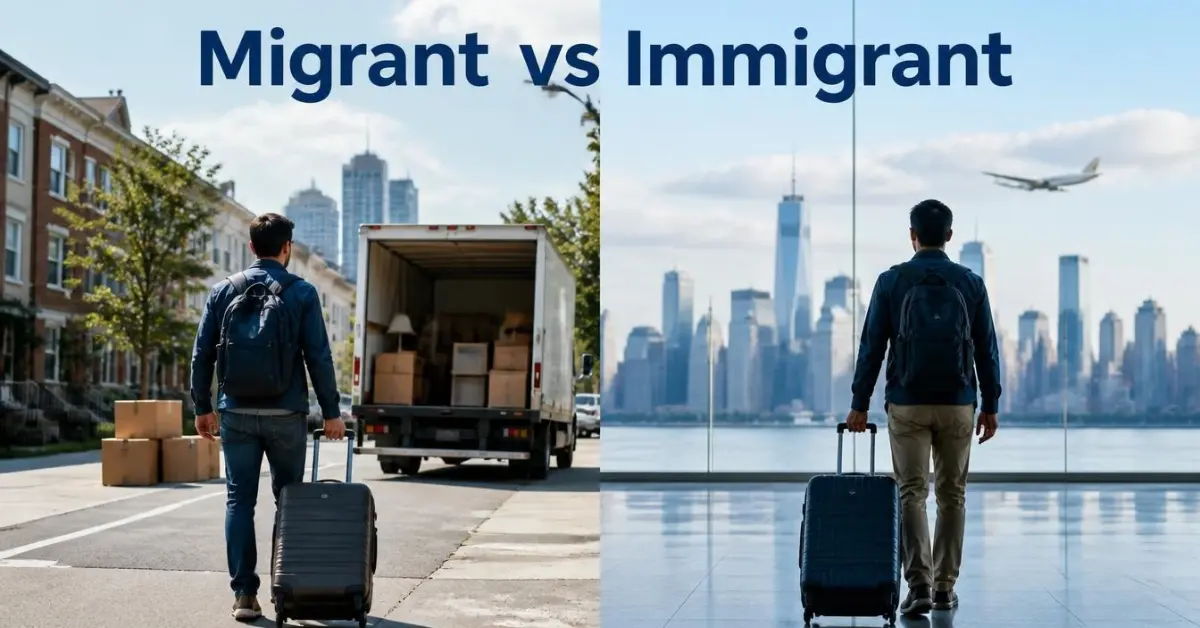
The main difference between a Migrant and an Immigrant is how broadly each term is used. A migrant is someone who moves from their usual place of residence, either within a country or across international borders.
An immigrant is generally someone who moves to another country intending to establish a new home there. Therefore, an immigrant is usually considered a type of migrant.
Key Takeaways
- A migrant is someone who moves from their usual place of residence, temporarily or permanently.
- An immigrant is generally someone who moves to another country to settle there.
- Migration can happen within one country or across international borders.
- Immigration usually involves crossing an international border.
- A person can be both a migrant and an immigrant, depending on the context.
The words migrant and immigrant are often used in discussions about people moving between places. Although they are closely related, they do not always mean the same thing.
For example, a person who moves from Texas to California can be described as an internal migrant. However, someone who moves from Mexico to the United States to build a permanent home is generally described as an immigrant.
Understanding the difference between migrant vs immigrant helps you use these terms correctly in everyday conversations, news articles, education, and discussions about immigration.
What Is A Migrant?
A migrant is a person who moves away from their usual place of residence to live somewhere else. This movement can happen within the same country or across international borders.
People migrate for many reasons, including employment, education, family, safety, and better living opportunities. Some move for a short period, while others establish a new home permanently.
According to the United Nations, migration can involve movement regardless of a person’s legal status, reason for moving, or length of stay. Therefore, migrant is a broad term that covers many different situations.
Examples of Migrants
Here are some everyday examples:
- Seasonal workers: People who move to another region to work during farming or harvesting seasons.
- International students: Students who move to another country to attend a university or college.
- Internal migrants: People who move from one city or state to another within their own country.
- Migrant workers: People who travel to different locations to find employment.
- International migrants: People who move across national borders to live in another country.
For example, a worker who moves from Florida to New York for a temporary job can be called a migrant. The person has changed their usual place of residence without necessarily moving to another country.
What Is An Immigrant?
An immigrant is generally a person who moves from their home country to another country with the intention of establishing a new residence.
Immigration usually involves a long-term or permanent move rather than a short visit. People may immigrate to join family members, find employment, continue their education, or build a new life.
In everyday English, someone who moves from India to the United States intending to settle there is commonly called an immigrant.
However, the legal meaning can depend on the country. In the United States, immigration law generally uses immigrant to refer to someone admitted for lawful permanent residence, commonly known as a green card holder.
Examples of Immigrants
Consider these situations:
- Family immigration: A person moves to the United States to live with close family members.
- Employment-based immigration: Someone moves to another country through an eligible permanent employment-based immigration process.
- Permanent relocation: A family leaves its home country and establishes a permanent residence elsewhere.
- Family reunification: A person joins relatives who have already settled in another country.
For example, a family that moves from Brazil to the United States to establish a permanent home can generally be described as an immigrant family.
Migrant vs Immigrant: Key Differences
Although both words describe movement, their meanings differ in several important ways. The biggest distinction is that migrant has a broader meaning, while immigrant usually refers to someone moving to another country to settle.
| Feature | Migrant | Immigrant |
| Meaning | Person who moves from their usual residence | Person who moves to another country to settle |
| Movement | Within or across borders | Across international borders |
| Duration | Temporary or permanent | Generally long-term or permanent |
| Destination | May be within the same country or abroad | Another country |
| Main focus | The act of moving | Moving into a new country |
| Example | A worker moving between states | A person settling in the USA from abroad |
Let’s examine the differences more closely.
1. Meaning and Definition
The word migrant describes a person who moves from one location to another. It does not necessarily mean that the person intends to settle permanently.
In contrast, immigrant usually describes someone who enters another country to establish a new home.
For example, a person who travels from one state to another for seasonal work is a migrant. Someone who moves from Germany to the United States to establish permanent residence is an immigrant.
2. Movement and Destination
Another important difference is where the person moves.
Migration can happen inside national borders or between countries. Immigration, however, involves movement into another country.
For example, someone who moves from Chicago to Los Angeles is an internal migrant. A person who moves from Canada to the United States is an international immigrant from the American perspective.
This distinction makes migrant a broader word than immigrant.
3. Temporary vs. Permanent Residence
Migrants may move temporarily or permanently. Some travel for seasonal employment, education, or short-term opportunities before returning home.
Immigrants generally intend to establish a longer-term home in their destination country.
For instance, an international student attending a four-year university may be described as a migrant in a broad sense. However, the student is not automatically an immigrant under U.S. immigration law.
This is because the United States distinguishes between immigrant and nonimmigrant classifications.
4. Legal and Social Usage
The two words also have different meanings in legal and everyday discussions.
In ordinary conversations, immigrant often describes someone who moves to another country to settle. Migrant can describe a wider range of people who relocate for different reasons.
In the United States, immigration law gives the word immigrant a more specific meaning. It generally refers to someone admitted as a lawful permanent resident.
Therefore, a person may be described as a migrant in a general discussion without having immigrant status under U.S. law.
5. Reasons for Moving
People migrate or immigrate for many different reasons.
Common reasons include:
- Finding better employment opportunities.
- Joining family members.
- Attending schools or universities.
- Seeking improved living conditions.
- Escaping conflict or persecution.
- Finding a safer place to live.
The reason for moving does not automatically determine whether someone is an immigrant or migrant. The destination, duration, and context also matter.
Can Someone Be Both A Migrant and An Immigrant?
Yes. A person can be both a migrant and an immigrant.
The terms are not mutually exclusive. In fact, immigration is commonly understood as one form of international migration.
For example, imagine someone who moves from Pakistan to the United States to establish a permanent home.
- The person is a migrant because they have moved from their usual place of residence.
- The person is an immigrant from the American perspective because they have moved into the United States.
- The person is an emigrant from Pakistan’s perspective because they have left their home country.
This example shows how the same person can have different labels depending on the context.
Migrant vs Immigrant vs Emigrant
The word emigrant is another term that often creates confusion. Although it is related to migrant and immigrant, it describes movement from the perspective of the country a person leaves.
Here is a simple comparison:
| Term | Meaning | Example |
| Migrant | Someone who moves from their usual residence | A person relocating for work |
| Immigrant | Someone moving into another country to settle | Someone moving to the USA from France |
| Emigrant | Someone leaving their home country | Someone leaving France to live in the USA |
The easiest way to remember these words is:
- Migrant: Focuses on the movement.
- Immigrant: Focuses on entering a country.
- Emigrant: Focuses on leaving a country.
These terms describe different perspectives on international movement.
How Are These Terms Used in the United States?
In the United States, the words migrant and immigrant appear in news reports, government publications, education, and everyday conversations.
However, their meanings can change depending on the situation.
For example, the Centers for Disease Control and Prevention (CDC) describes migrants broadly as people who move away from their usual residence, either within a country or across an international border. It also explains that U.S. immigration law uses a more specific definition of immigrant connected to lawful permanent residence.
Another important point is that not everyone entering the United States from another country becomes a lawful permanent resident.
Consider these categories:
- Permanent residents: People who have permission to live permanently in the United States.
- Temporary workers: People who enter under qualifying temporary employment classifications.
- International students: People who enter under student visa classifications.
- Refugees: People admitted through a specific protection process.
- Asylum seekers: People requesting protection whose applications have not yet been decided.
These groups have different legal classifications and should not automatically be treated as interchangeable.
Using accurate terms helps readers understand a person’s circumstances without making assumptions about their legal status.
Migrant vs Immigrant: Real-Life Examples
The following examples make the difference easier to understand.
| Situation | Correct general term |
| A family moves from Ohio to Texas | Internal migrants |
| A student moves from India to the USA temporarily | International migrant |
| A person moves from Spain to the USA to settle | Immigrant |
| A worker travels to another state for seasonal employment | Migrant worker |
| Someone leaves Canada to establish a home in Australia | Emigrant from Canada; immigrant to Australia |
These examples show that the words depend on the person’s movement and the perspective being used.
Common Mistakes When Using Migrant and Immigrant
People sometimes use migrant and immigrant as if they have exactly the same meaning. Although they overlap, this can create confusion.
Here are some common mistakes to avoid:
1. Assuming every migrant is an immigrant.
This is incorrect because migrants can move within their own country without crossing an international border.
2. Assuming every migrant intends to settle permanently.
Some people move for temporary employment, education, or seasonal opportunities.
3. Confusing immigrants with refugees.
Refugees are people who meet specific protection criteria. Their circumstances are different from those of people who move for ordinary employment or educational opportunities.
4. Treating legal status and everyday terminology as identical.
A person can be described as a migrant in general language without being classified as an immigrant under a country’s immigration laws.
The best approach is to use the most accurate term for the person’s situation.
FAQs:
1. Are migrants and immigrants the same thing?
No. Migrants and immigrants are related terms, but they have different meanings. A migrant is someone who moves from their usual place of residence, either within a country or internationally. An immigrant generally moves into another country intending to establish a new home. Therefore, immigrants are commonly considered a type of migrant.
2. Is every immigrant a migrant?
Generally, yes. An immigrant moves from one country to another, so the person also fits the broad meaning of an international migrant. However, not every migrant is an immigrant because some people move within their own country or relocate temporarily without intending to settle abroad.
3. Is a refugee considered an immigrant?
A refugee is a person who needs international protection because of persecution or other qualifying threats under applicable refugee protection rules. Refugees may also be included in broader migrant or immigrant population discussions, depending on the definition being used. However, refugee is a distinct protection category and should not be replaced with migrant when refugee status is relevant.
4. Can someone be a migrant without crossing a border?
Yes. A person can be an internal migrant by moving from one place to another within the same country. For example, someone who relocates from a small town in California to New York City for employment is an internal migrant. International borders do not need to be crossed for migration to occur.
5. Why do people migrate to another country?
People migrate for many reasons, including employment, education, family reunification, safety, and better living opportunities. Some move voluntarily to pursue new opportunities, while others leave because of conflict, persecution, or difficult living conditions. The reasons and circumstances vary from person to person.
Conclusion:
Understanding Migrant vs Immigrant becomes easier when you remember that the two words describe different aspects of movement.
A migrant is a broad term for someone who moves away from their usual residence, either temporarily or permanently. An immigrant generally refers to someone who moves into another country intending to establish a new home.
Although the terms overlap, they are not always interchangeable. Migrants can move within their own country, while immigrants move across international borders. In the United States, the legal definition of an immigrant also has a specific connection to lawful permanent residence.
Ultimately, using the correct term depends on the person’s circumstances and the context in which the word is being used.