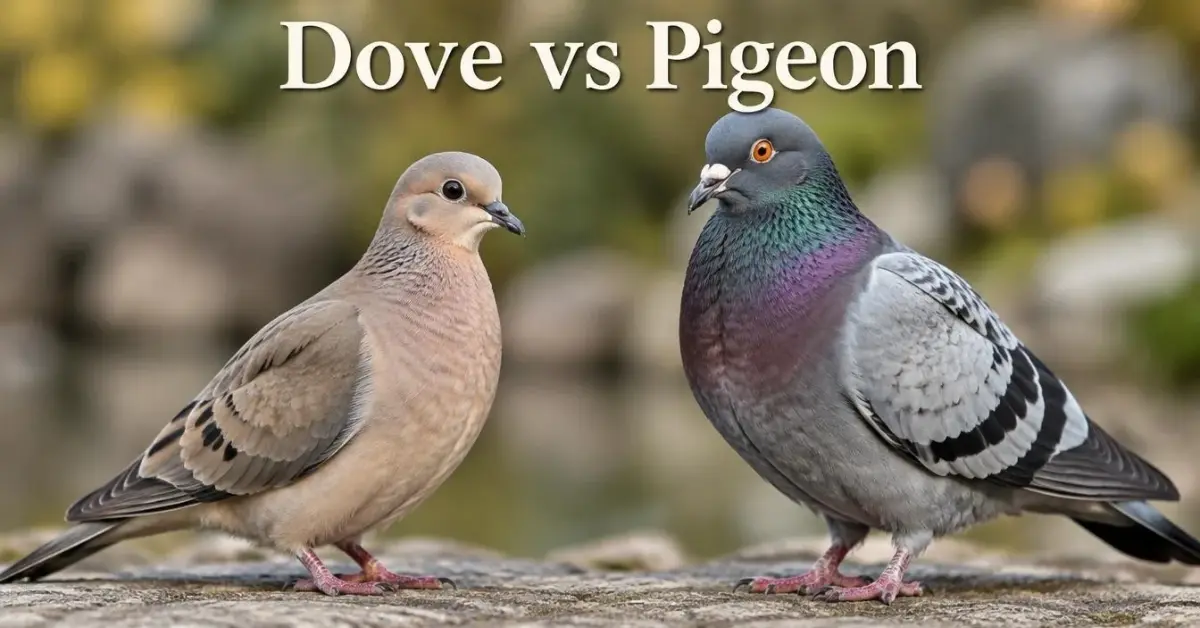
Doves and Pigeons belong to the same bird family, called Columbidae. There is no strict scientific difference between them. However, people usually call smaller, slimmer birds doves and larger, stockier birds pigeons.
They share many features, including similar diets, nesting habits, and behaviors, but individual species have different appearances and habitats.
Key Takeaways
- Doves and pigeons belong to the same scientific family, Columbidae.
- People usually use the word dove for smaller birds and pigeon for larger ones.
- Both birds eat seeds, grains, fruits, and other plant-based foods.
- Mourning doves and rock pigeons are two familiar species in the United States.
- Their names do not represent two separate scientific groups.
Are Doves and Pigeons The Same Bird?
Yes, doves and pigeons are members of the same bird family. Scientists classify both groups under the family Columbidae. This family includes hundreds of species found in different parts of the world.
The main difference comes from how people name these birds, not from their scientific classification.
For example, a small, slender bird sitting on a tree branch may be called a dove. A larger, rounder bird walking around a city park is usually called a pigeon.
However, this naming pattern does not apply to every species. Some birds called pigeons are smaller than certain birds called doves.
The Columbidae Bird Family
The Columbidae family includes many types of birds with shared physical features.
Most members have:
- Short legs and compact bodies.
- Small heads and slender bills.
- Strong wings for flying.
- Soft feathers in different colors.
- A diet that often includes seeds, grains, and fruits.
These birds also share similar nesting and parenting habits. Both parents usually help care for their young.
According to the Integrated Taxonomic Information System (ITIS), Columbidae is a recognized bird family. Its common English names include both doves and pigeons.
Why People Use Different Names
The words dove and pigeon have developed through everyday language and cultural traditions.
Many people connect doves with peace, love, and special ceremonies. White doves often appear in artwork, weddings, and religious traditions.
Pigeons, on the other hand, are commonly associated with city streets, public parks, and buildings.
These cultural ideas influence how people describe the birds, but they do not create a scientific difference.
Dove vs Pigeon: Main Differences
Although both birds belong to the same family, some common species have noticeable differences.
The following table compares the typical appearance and behavior of a mourning dove and a rock pigeon.
| Feature | Dove (Mourning Dove) | Pigeon (Rock Pigeon) |
| Scientific name | Zenaida macroura | Columba livia |
| Body size | Smaller and slimmer | Larger and stockier |
| Body color | Soft brown and gray | Often blue-gray |
| Neck | Relatively slender | Shorter and thicker |
| Tail | Long and pointed | Broad and rounded |
| Common habitat | Fields, gardens, and woodlands | Cities, parks, and rocky areas |
| Sound | Soft, mournful cooing | Deeper, repetitive cooing |
| Social behavior | Often seen alone or in pairs | Frequently gathers in flocks |
Note: These are comparisons between two common species, not universal rules for every dove and pigeon.
Physical Differences Between Doves and Pigeons
Appearance is one of the easiest ways to compare familiar dove and pigeon species. However, size and color can vary widely across the Columbidae family.
Body Size and Shape
Mourning doves generally have smaller, slimmer bodies than rock pigeons.
A mourning dove has a lightweight appearance, a small head, and a long, pointed tail. Its body looks narrow when it sits on a branch or flies across an open field.
A rock pigeon has a heavier body, a rounder chest, and a shorter neck. Its broad wings and rounded tail give it a stockier appearance.
Rock pigeons commonly measure around 11.8 to 14.2 inches in length. They are generally larger than mourning doves.
Color and Feather Patterns
Color provides another useful identification clue. Mourning doves usually have soft brown, gray, and tan feathers. Their wings may show small dark spots, while their long tails have white edges.
Rock pigeons often have blue-gray feathers, two dark wing bars, and an iridescent green or purple neck.
However, not every pigeon has the same colors. Domestic breeding has produced pigeons with white, black, brown, and mixed-color feathers.
This means you should not identify a bird by color alone.
Beak and Head Shape
Mourning doves have small heads and slender, dark bills. Their overall shape looks delicate compared with many common pigeons.
Rock pigeons have relatively larger heads and short, slender bills. They also have a noticeable fleshy area at the base of the upper bill, called the cere.
These features can help birdwatchers distinguish the two familiar species.
Behavior and Temperament
Doves and pigeons share many behaviors because they belong to the same bird family. However, their daily activities can differ depending on their species and surroundings.
Feeding Habits
Both birds mainly eat plant-based foods.
Their diets commonly include:
- Grass seeds.
- Wild seeds.
- Grains.
- Small fruits.
- Other available plant materials.
Mourning doves often search for seeds on the ground in fields, gardens, and open spaces.
Rock pigeons also feed on the ground. In cities, they often search for food around sidewalks, parks, public squares, and buildings.
Their ability to use different food sources helps them live in many environments.
Social Behavior
Rock pigeons often gather in large groups. You may see them walking together in parks, resting on rooftops, or flying in flocks.
Mourning doves are commonly seen alone or in pairs. However, they can also gather in groups, especially when food is easy to find.
Neither bird is always more social or friendly than the other. Their behavior depends on food availability, nesting conditions, and their surroundings.
Sounds and Communication
Both birds use cooing sounds to communicate.
Mourning doves produce a soft, low call that many people describe as sad or mournful. This sound gives the bird its common name.
Rock pigeons make deeper, repetitive cooing sounds. They also use different calls and body movements during courtship and social interactions.
Listening to their calls can help you identify them when you cannot see the birds clearly.
Habitat and Nesting Habits
Doves and pigeons live in a wide range of environments.
Mourning doves commonly inhabit open fields, grasslands, farms, gardens, and woodland edges. They often choose trees, shrubs, or other raised areas for nesting.
Rock pigeons are especially common in cities and towns. They use rooftops, bridges, balconies, and building ledges as nesting sites.
These urban locations provide shelter and resemble the rocky cliffs where wild rock pigeons naturally nest.
Both birds build relatively simple nests using small sticks and other plant materials.
They also share an interesting parenting behavior: adult members of the Columbidae family produce a nutritious substance called crop milk. Both parents can feed this substance to their young.
This is one of the distinctive features shared by pigeons and doves.
Common Doves and Pigeons In The United States
Several members of the Columbidae family live in the United States. Learning their names and features can make bird identification easier.
Common Dove Species
1. Mourning Dove
Mourning doves are common across much of the United States. They have gray-brown feathers, long pointed tails, and soft cooing calls. They often visit gardens, fields, and open areas.
2. White-Winged Dove
This dove has a noticeable white stripe along its wings. It is especially familiar in the southwestern United States and parts of the southern region.
3. Eurasian Collared-Dove
This bird has pale gray feathers and a distinctive black collar around the back of its neck. It is now established in many parts of the United States.
Common Pigeon Species
1. Rock Pigeon
Rock pigeons are familiar in American cities and towns. They often have blue-gray bodies, dark wing bars, and shiny neck feathers.
2. Domestic Pigeon
Domestic pigeons are descended from rock pigeons. People have bred them for different colors, feather patterns, appearances, and other traits.
These examples show why common names can be confusing. The birds may look very different, but they all belong to the same family.
Can Doves and Pigeons Mate?
Some closely related dove and pigeon species can produce hybrids, but this does not mean every dove can mate with every pigeon.
Successful breeding depends on their genetic relationship, compatibility, and reproductive biology.
Because the terms dove and pigeon cover many different species, there is no single answer that applies to every possible pairing.
The important point is that these names do not represent two separate scientific families. They describe birds within the same broader family.
FAQs:
1. Are doves and pigeons the same bird?
Doves and pigeons belong to the same bird family, Columbidae. However, they are not all the same species. The names describe different members of this large family, and people often use them based on appearance and tradition.
2. Which is bigger, a dove or a pigeon?
A common rock pigeon is generally larger and heavier than a mourning dove. However, size varies among species. Some birds called doves can be quite large, so the name alone does not tell you how big a bird will be.
3. Are doves more peaceful than pigeons?
No scientific rule says doves are more peaceful than pigeons. Both can show calm or defensive behavior depending on their surroundings. Doves have a stronger cultural connection with peace, but that symbolism does not mean they always behave differently.
4. Do doves and pigeons eat the same food?
Yes, their diets overlap significantly. Both commonly eat seeds, grains, and fruits. Their exact food choices depend on the species and available resources. Urban pigeons may also eat human food scraps when they find them.
5. Are mourning doves related to city pigeons?
Yes. Mourning doves and city pigeons belong to the Columbidae family. However, they are different species with different scientific names. Mourning doves belong to the genus Zenaida, while rock pigeons belong to the genus Columba.
6. Why are white pigeons sometimes called doves?
White pigeons are often called doves because people associate white birds with peace, love, and special ceremonies. However, a bird’s white feathers do not automatically make it a different species. Many white domestic pigeons are simply color varieties of rock pigeons.
Conclusion:
The main difference in the Dove vs Pigeon comparison comes down to common naming rather than scientific classification. Both birds belong to the Columbidae family, and there is no strict biological rule separating them.
People generally use dove for smaller, slimmer birds and pigeon for larger, stockier ones. However, this distinction has exceptions.
If you want to identify these birds, focus on their size, feather patterns, body shape, calls, and habitat instead of relying only on their names. Understanding their shared family makes it easier to recognize the similarities and differences between these familiar birds.