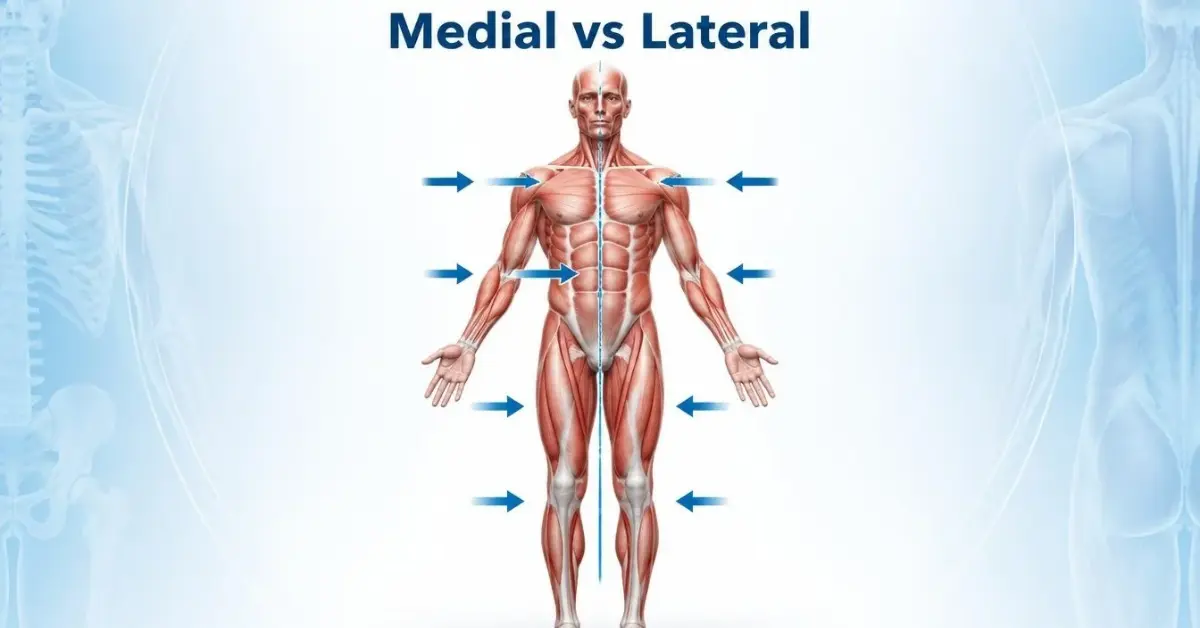
Medial vs Lateral describes two opposite directions in human anatomy. Medial means closer to or toward the body’s midline, which divides the body into right and left halves. Lateral means farther from or away from the midline, toward the body’s outer sides.
For example, the nose is medial to the eyes, while the ears are lateral to the eyes.
Key Takeaways
- Medial means toward the middle or midline of the body.
- Lateral means away from the midline and toward the outer sides.
- The nose is medial to the eyes, while the ears are lateral to the nose.
- These terms describe the relative positions of body structures.
- Medial and lateral are commonly used in anatomy, healthcare, medical education, and physical examinations.
What Does Medial Mean In Anatomy?
Medial is an anatomical directional term that describes a position closer to or toward the middle of the body.
The body’s midline is an imaginary vertical line that divides the body into two sides: right and left. This line runs from the head down through the center of the body.
A structure is medial when it lies closer to this imaginary line than another structure.
For example, the nose is medial to the eyes because it sits closer to the center of the face. Similarly, the heart is medial to the lungs because it lies between them, closer to the body’s midline.
Medical professionals, anatomy students, and healthcare workers use this term to describe the positions of organs, bones, muscles, and other body structures.
Examples of Medial Body Structures
Here are some simple examples of medial positions:
- Nose: The nose is medial to both eyes because it sits near the center of the face.
- Heart: The heart is medial to the lungs because it lies between them.
- Big toe: The big toe is medial to the other toes when the body is in anatomical position.
- Inner thigh: The inner thigh is closer to the body’s midline than the outer thigh.
- Navel: The navel is medial to the sides of the abdomen.
These examples show how medial describes a position closer to the center rather than a particular body part.
What Does Lateral Mean In Anatomy?
Lateral is the opposite of medial. It describes a position farther from or away from the body’s midline.
A lateral structure lies toward the outer side of the body. For example, the ears are lateral to the nose because they are farther from the center of the face.
The arms are also lateral to the chest because they extend outward from the body’s central region.
This term helps describe the locations of muscles, bones, organs, and other anatomical structures. It is especially useful when comparing structures on the right and left sides of the body.
Examples of Lateral Body Structures
The following examples explain lateral positions:
- Ears: The ears are lateral to the nose because they sit on the outer sides of the head.
- Eyes: Each eye is lateral to the nose.
- Little toe: The little toe is lateral to the big toe when the body is in anatomical position.
- Outer thigh: The outer thigh is lateral to the inner thigh.
- Arms: The arms are lateral to the chest because they are positioned farther from the body’s midline.
Remember that lateral does not always mean the farthest possible point from the center. It simply describes a position farther from the midline compared with another structure.
Medial vs Lateral: Key Differences
Medial and lateral are opposite anatomical directional terms. Both describe where one body structure is located in relation to another.
The main difference is their direction from the body’s midline.
| Feature | Medial | Lateral |
| Meaning | Toward the midline | Away from the midline |
| Direction | Toward the center | Toward the sides |
| Position | More central | More outward |
| Opposite term | Lateral | Medial |
| Face example | Nose | Ears |
| Foot example | Big toe | Little toe |
| Leg example | Inner thigh | Outer thigh |
The easiest way to understand medial vs lateral is to imagine a line running down the center of your body. Structures closer to that line are medial, while structures farther away are lateral.
Medial vs Lateral Examples In The Human Body
Understanding examples makes these anatomical terms easier to remember. You can identify medial and lateral positions in different areas of the human body.
1. Face
The face provides one of the simplest examples of medial and lateral positions.
The nose is located near the center of the face, so it is medial to the eyes. The eyes are lateral to the nose, while the ears are farther toward the outer sides of the head.
For example:
- The nose is medial to the eyes.
- The eyes are lateral to the nose.
- The ears are lateral to the eyes.
2. Hands and Fingers
The hands also demonstrate medial and lateral directions.
In anatomical position, a person stands upright with the palms facing forward. In this position, the thumb is on the outer side of the hand, while the little finger is closer to the body’s midline.
For example:
- The thumb is lateral to the index finger.
- The little finger is medial to the thumb.
- The thumb is lateral to the other fingers.
This example is especially helpful because hand orientation can confuse beginners. Always use the standard anatomical position when identifying these directions.
3. Legs and Feet
Medial and lateral are common terms in lower-limb anatomy.
The big toe is on the medial side of the foot, while the little toe is on the lateral side. Similarly, the inner thigh is medial compared with the outer thigh.
For example:
- The big toe is medial to the little toe.
- The little toe is lateral to the big toe.
- The inner thigh is medial to the outer thigh.
These terms are useful when learning about leg muscles, bones, joints, and movement.
4. Chest and Shoulders
The chest and shoulders provide another useful example.
The breastbone, also called the sternum, lies near the body’s midline. The shoulders sit farther away from this line.
Therefore:
- The sternum is medial to the shoulders.
- The shoulders are lateral to the sternum.
- The arms are lateral to the chest.
These relationships help students understand how anatomical structures are positioned in the upper body.
Medial vs Lateral Knee: What’s The Difference?
In knee anatomy, medial and lateral describe the two sides of the knee joint.
The medial side is the inner side of the knee, closer to the body’s midline. On the right knee, this is the left-facing side. On the left knee, it is the right-facing side.
The lateral side is the outer side of the knee, farther from the body’s midline.
The knee contains structures on both sides, including ligaments and other supporting tissues.
For example:
- The medial collateral ligament (MCL) is located on the inner side of the knee.
- The lateral collateral ligament (LCL) is located on the outer side of the knee.
These terms describe anatomical locations, not a diagnosis or the cause of knee pain.
Understanding this difference helps students follow anatomy lessons and understand medical descriptions of knee structures.
Medial vs Lateral vs Other Anatomical Directions
Medial and lateral are part of a larger group of anatomical directional terms. These terms help describe the positions of different body structures accurately.
Here is how they compare with other common directions:
| Anatomical Term | Meaning | Example |
| Medial | Toward the midline | The nose is medial to the eyes. |
| Lateral | Away from the midline | The ears are lateral to the nose. |
| Anterior | Toward the front | The sternum is anterior to the heart. |
| Posterior | Toward the back | The spine is posterior to the sternum. |
| Superior | Toward the head | The head is superior to the chest. |
| Inferior | Toward the feet | The stomach is inferior to the heart. |
| Proximal | Closer to a limb’s attachment | The elbow is proximal to the wrist. |
| Distal | Farther from a limb’s attachment | The fingers are distal to the wrist. |
Important distinction: Medial and lateral describe positions relative to the body’s midline. Proximal and distal describe positions relative to the origin or attachment of a body part, especially a limb.
For example, the elbow is proximal to the wrist, but the nose is medial to the eyes.
How to Remember Medial vs Lateral
If you find these terms confusing, use a simple memory trick.
- Medial = Middle: Both words begin with the letter “M.” Think of medial as moving toward the middle of the body.
- Lateral = Laterally outward: Think of lateral as moving toward the left or right outer sides of the body.
You can also practice with your own body:
- Stand upright with your arms at your sides.
- Imagine a vertical line running through the center of your body.
- Identify body parts closer to this line. These are medial.
- Identify body parts farther from this line. These are lateral.
For example, your nose is medial to your eyes, while your ears are lateral to your eyes.
This simple method can help you remember the difference during anatomy lessons and exams.
Common Mistakes When Using Medial and Lateral
Students sometimes confuse medial and lateral because they describe positions rather than specific body parts.
Here are some common mistakes to avoid:
1. Thinking medial always means inside
Medial does not always mean inside an organ or body structure. It means closer to the body’s midline.
2. Thinking lateral always means outside
Lateral refers to a position farther from the midline. It does not necessarily mean outside the body.
3. Confusing medial with proximal
Medial describes a position toward the body’s center. Proximal describes a position closer to the point of attachment or origin of a limb.
4. Forgetting anatomical position
The standard anatomical position provides a consistent reference for describing body structures. Without it, students may confuse the medial and lateral sides of the hands and feet.
5. Treating medial and lateral as fixed positions
These terms are relative. A structure can be medial to one body part but lateral to another.
Understanding these differences makes anatomical terminology easier to use correctly.
FAQs:
1. What is the difference between medial and lateral?
Medial means closer to or toward the body’s midline, while lateral means farther from or away from the midline. For example, the nose is medial to the eyes, whereas the ears are lateral to the nose. These terms help describe the relative positions of body structures.
2. Is medial inside or outside?
Medial generally refers to the inner direction toward the body’s midline. However, it does not mean inside an organ or body cavity. It describes the location of one anatomical structure compared with another structure.
3. Is lateral the same as outer?
Lateral generally means toward the outer sides of the body, away from the midline. However, it does not always mean the outermost part of a structure. It describes a relative position rather than a fixed location.
4. Is the nose medial or lateral to the eyes?
The nose is medial to the eyes because it sits closer to the center of the face. Both eyes are lateral to the nose because they are positioned farther from the body’s midline.
5. Is the thumb medial or lateral?
The thumb is lateral in the standard anatomical position because it sits on the outer side of the hand. The little finger is more medial because it is closer to the body’s midline.
6. What is the opposite of medial?
The opposite of medial is lateral. Medial describes a direction toward the body’s midline, while lateral describes a direction away from it. These terms are commonly used together in anatomy to compare the positions of body structures.
7. Can a body part be both medial and lateral?
Yes. A body part can be medial to one structure and lateral to another. For example, the eyes are lateral to the nose but medial to the ears. The terms depend on which structures you are comparing.
Conclusion:
Understanding Medial vs Lateral is important for learning human anatomy and medical terminology. Medial means toward the body’s midline, while lateral means away from the midline toward the outer sides.
Simple examples make the difference easier to understand. The nose is medial to the eyes, the ears are lateral to the nose, and the big toe is medial to the little toe.
Remember the basic rule: medial means toward the middle, and lateral means toward the sides. Once you understand this relationship, identifying anatomical directions becomes much easier.

Eric Walker, an author at replyygenius.com, where I create clear and helpful content for readers.
I focus on writing useful, engaging, and easy to understand articles that deliver real value.