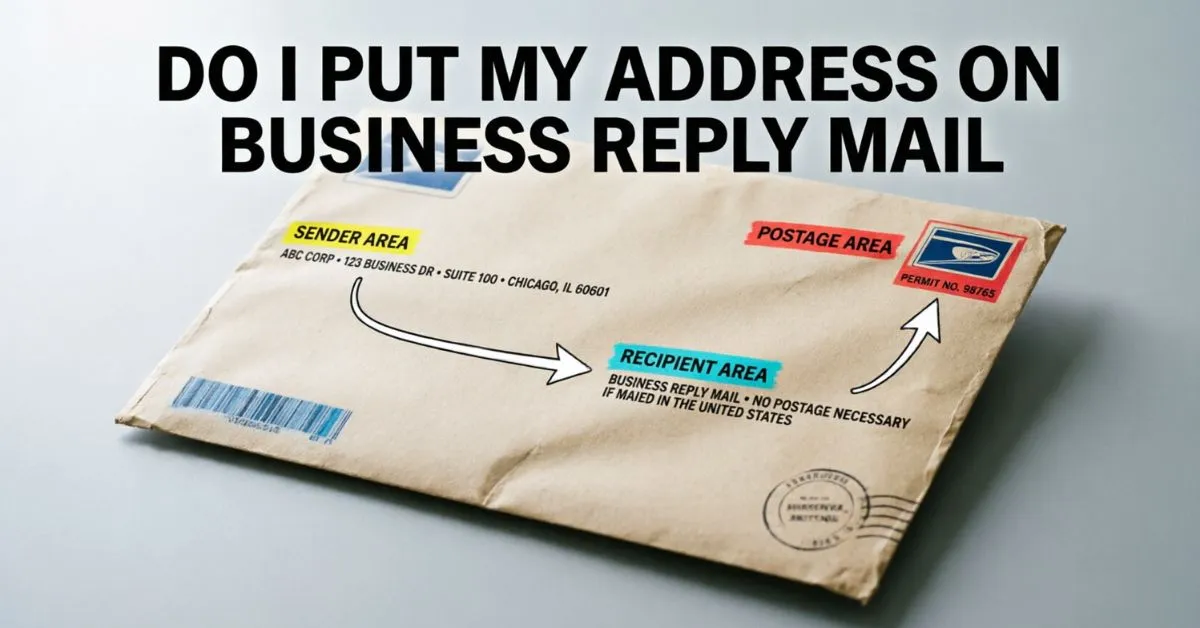
I still remember the day I received a Business Reply Mail envelope and paused for a moment, wondering, “Do I put my address on Business Reply Mail?” I wasn’t sure if I needed to write my return address or leave the envelope exactly as it was.
To avoid making a mistake, I spent some time checking the instructions and learning how Business Reply Mail actually works. What I discovered was surprisingly simple and saved me from unnecessary confusion.
If you’ve ever held a Business Reply Mail envelope and asked yourself the same question, you’re not alone. I faced the exact issue, and once I understood the correct process, sending it back became quick and stress-free.
In this guide, I’ll walk you through everything I learned so you can confidently mail your Business Reply Mail without worrying about missing any important details.
What Is Business Reply Mail?
Business Reply Mail (BRM) is a service that allows customers to send mail back to a company without paying postage.
The receiving company pays the postage costs instead of the sender.
This makes it easier for customers to respond to:
- Surveys
- Applications
- Registration forms
- Product warranty cards
- Customer feedback forms
- Donation requests
- Subscription renewals
Many businesses use BRM because it increases response rates and improves customer engagement.
Key Features of Business Reply Mail
- No stamp required for the sender
- Pre-addressed envelope or postcard
- Faster customer response process
- Commonly used for marketing campaigns
- Accepted through the postal service
Do I Put My Address on Business Reply Mail?
The Short Answer
Yes, in many cases you should include your address on business reply mail if the company requests it or if your response requires identification.
However, not every business reply mail piece requires your address.
The correct answer depends on:
- The instructions provided
- The purpose of the mail
- Whether the company needs to identify you
- Whether a response will be sent back to you
When You Should Put Your Address on Business Reply Mail
There are several situations where adding your address is important.
1. When the Form Requests Your Address
If the form includes fields such as:
- Street address
- City
- State
- ZIP code
You should complete them accurately.
Companies often use this information to:
- Verify customer records
- Send follow-up information
- Process applications
- Deliver products or rewards
2. When You Expect a Response
If you’re asking for:
- Product information
- A replacement item
- Customer support
- A refund
- A rebate
Your mailing address may be required so the company can respond.
3. When Returning Official Documents
Certain documents require identity verification.
Examples include:
- Insurance paperwork
- Tax-related forms
- Membership applications
- Financial account updates
In these cases, your address helps confirm your identity.
4. When Participating In Surveys or Promotions
Some companies offer incentives for completing surveys.
These may include:
- Coupons
- Gift cards
- Free samples
- Contest entries
Your address may be needed to deliver rewards.
When You May Not Need To Include Your Address
There are also situations where your address may not be necessary.
Anonymous Surveys
Some businesses conduct anonymous surveys to collect honest feedback.
If anonymity is requested:
- Leave address fields blank if allowed
- Follow all instructions carefully
General Feedback Forms
Some feedback cards only ask for comments.
In these cases, your address may be optional.
Pre-Identified Customer Responses
Sometimes a business reply mail piece contains:
- Customer ID numbers
- Account numbers
- Personalized tracking codes
These identifiers may already connect your response to your account.
Why Companies Ask For Your Address
Understanding the reason behind address requests can help you decide what information to provide.
Customer Verification
Businesses use addresses to confirm customer identity.
Record Keeping
Accurate records help companies:
- Maintain customer databases
- Track communications
- Improve customer service
Mailing Responses
Some replies require physical delivery.
Examples include:
- Replacement products
- Checks
- Certificates
- Promotional materials
Legal Compliance
Certain industries must maintain accurate customer records.
These industries include:
- Banking
- Insurance
- Healthcare
- Government agencies
How To Fill Out Business Reply Mail Correctly
Following a few simple steps can prevent delays.
Step 1: Read All Instructions
Always review the entire form before writing anything.
Look for:
- Required fields
- Optional fields
- Special instructions
Step 2: Use Accurate Information
Double-check:
- Name spelling
- Address details
- ZIP code
- Contact information
Errors can slow processing.
Step 3: Write Clearly
Use:
- Blue or black ink
- Neat handwriting
- Block letters if requested
Clear writing reduces mistakes.
Step 4: Include Additional Details if Requested
Some forms may ask for:
- Account numbers
- Customer IDs
- Order numbers
Provide only the information requested.
Step 5: Review Before Mailing
Before sealing the envelope, verify that:
- All required fields are completed
- Documents are included
- Signatures are present
Common Mistakes People Make
Many people accidentally create delays by making simple errors.
Leaving Required Address Fields Blank
If an address is required, omitting it may prevent processing.
Using an Old Address
Always provide your current address.
Providing Incomplete Information
Missing:
- Apartment numbers
- ZIP codes
- City names
can cause delivery issues.
Ignoring Instructions
Every business reply mail piece may have different requirements.
Writing Illegibly
Poor handwriting can lead to incorrect data entry.
Example Scenarios
Let’s look at some practical examples.
Example 1: Warranty Registration
You purchase a new appliance and receive a warranty card.
Should you include your address?
Yes.
The manufacturer may need it for:
- Warranty verification
- Product recalls
- Customer support
Example 2: Customer Satisfaction Survey
A restaurant sends a survey asking for feedback.
Should you include your address?
Only if requested or if you want follow-up contact.
Example 3: Rebate Form
You submit a rebate request.
Should you include your address?
Absolutely.
The company needs it to send your rebate.
Example 4: Anonymous Market Research Survey
The survey specifically states responses are anonymous.
Should you include your address?
Usually no, unless requested.
Business Reply Mail vs Regular Mail
Many people confuse business reply mail with standard mail.
| Feature | Business Reply Mail | Regular Mail |
| Postage Paid By | Recipient Company | Sender |
| Address Preprinted | Yes | Usually No |
| Customer Cost | Free | Requires Stamp |
| Response Tracking | Often Included | Limited |
| Business Purpose | Customer Replies | General Correspondence |
Understanding this difference helps ensure proper handling.
Privacy Considerations
Some people hesitate to provide their address due to privacy concerns.
Read the Privacy Policy
If available, review how the company uses customer information.
Provide Only Required Information
Avoid sharing unnecessary personal details.
Verify the Sender
Only respond to legitimate businesses.
Protect Sensitive Information
Never include information that isn’t requested.
Examples include:
- Social Security numbers
- Passwords
- Banking credentials
unless specifically required through secure channels.
Benefits of Including Your Address When Appropriate
Providing your address when needed offers several advantages.
Faster Processing
The company can quickly identify your account.
Better Customer Support
Support teams can access your records more easily.
Accurate Deliveries
Products and documents reach the correct location.
Improved Communication
Businesses can follow up when necessary.
Expert Tips For Professional Business Correspondence
To ensure smooth communication:
Keep Copies
Photocopy important documents before mailing.
Use Updated Information
Outdated addresses can create delays.
Respond Promptly
Quick responses often receive faster processing.
Follow Company Guidelines
Always prioritize instructions over assumptions.
Stay Organized
Maintain records of:
- Submission dates
- Tracking information
- Confirmation numbers
FAQs:
Q1: Do I put my address on business reply mail?
Yes, if the form requests your address or if the company needs it to identify you, process your request, or send a response.
Q2: Can I leave my address blank on business reply mail?
You can leave it blank only if the address field is optional and the instructions do not require it.
Q3: Does business reply mail require a stamp?
No. Business reply mail is designed so the receiving company pays the postage.
Q4: What happens if I forget to include my address?
Your response may be delayed, rejected, or impossible to process depending on the purpose of the mail.
Q5: Is business reply mail secure?
Generally, yes. However, only provide information to trusted organizations and follow privacy guidelines.
Q6: Should I include a return address on the envelope?
Usually, a return address is helpful, especially if the mail could be returned due to delivery issues.
Q7: Can companies respond without my address?
Sometimes. If they have other identifying information such as an account number or email address, they may still process your response.
Conclusion
So, Do I Put My Address On Business Reply Mail? In most cases, the answer is yes, especially when the company needs to identify you, process a request, verify records, or send a response. However, if the form is anonymous or clearly states that an address is optional, you may choose not to include it.
The safest approach is simple: read the instructions carefully and provide all required information accurately. Doing so helps avoid delays, ensures proper processing, and improves communication with the business.
If you’re returning a survey, submitting a rebate, registering a product, or responding to customer service, understanding how business reply mail works can save time and prevent mistakes.

Eric Walker, an author at replyygenius.com, where I create clear and helpful content for readers.
I focus on writing useful, engaging, and easy to understand articles that deliver real value.